

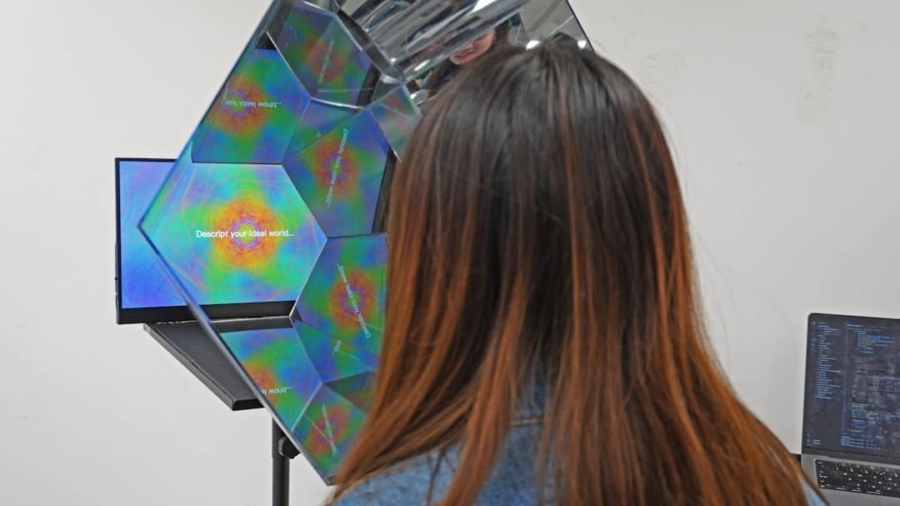
Spatial computing is going to fundamentally change how we design for the metaverse. Forget flat screens and traditional interfaces; we’re moving into a world where digital content seamlessly integrates with our physical surroundings, and that demands a whole new way of thinking about interaction, experience, and even the very fabric of digital spaces. It’s less about building a virtual world you visit, and more about augmenting the world you already inhabit.
When we talk about spatial computing in the metaverse, we’re essentially talking about computing that understands and interacts with the three-dimensional world around us. It’s not just about displaying a 3D model; it’s about that model having a spatial presence, understanding its location relative to you and other objects, and reacting accordingly.
Beyond the Screen: A New Dimension of Interaction
Right now, most of our digital interactions are confined to a screen – a rectangular window into a digital world. Spatial computing bursts through that window. Imagine interacting with a virtual object not by clicking on it, but by literally reaching out and touching it, or walking around it to see it from different angles. This shifts the paradigm from indirect manipulation to direct, embodied interaction.
The Role of Sensors and Real-World Data
For spatial computing to work its magic, it relies heavily on sensory input. This includes cameras, depth sensors, accelerometers, and gyroscopes on your device. These sensors continuously map your environment, track your movement, and understand the physical space you occupy. This real-world data isn’t just for navigation; it’s crucial for anchoring digital content accurately and ensuring a consistent experience.
From VR/AR to Mixed Reality: A Spectrum of Immersion
While often used interchangeably, it’s worth noting the distinction across the immersion spectrum. Virtual Reality (VR) fully immerses you in a digital world, blocking out your physical surroundings. Augmented Reality (AR) overlays digital information onto your real-world view. Spatial computing, at its core, underpins both but truly shines in Mixed Reality (MR), where digital and physical objects co-exist and interact in a meaningful way. This seamless blending is where much of the metaverse’s potential lies.
The Impact of Spatial Computing on Metaverse Design is a fascinating topic that explores how emerging technologies are reshaping virtual environments. For those interested in understanding how these advancements can enhance user experiences in retail, a related article on the concept of BOPIS (Buy Online, Pick Up In Store) provides valuable insights. This article discusses the integration of digital and physical shopping experiences, which is increasingly relevant in the context of spatial computing and the metaverse. You can read more about it here: What is BOPIS and How Does it Work?.
Key Takeaways
- Clear communication is essential for effective teamwork
- Active listening is crucial for understanding team members’ perspectives
- Setting clear goals and expectations helps to keep the team focused
- Encouraging open and honest feedback fosters a culture of continuous improvement
- Celebrating achievements and milestones boosts team morale and motivation
Shifting Paradigms in User Experience Design
The move to spatial computing necessitates a complete re-evaluation of how we design user experiences. What worked for a flat screen simply won’t translate directly to a 3D, interactive environment.
Intuitive Navigation and Wayfinding
In a spatial metaverse, users won’t just click links; they’ll move through spaces. This means designers need to consider naturalistic wayfinding. Think about how you navigate a physical building – signs, landmarks, open spaces and corridors. These same principles will be vital. Clear sightlines, intuitive environmental cues, and easy-to-understand directional guides will be paramount. Avoiding “getting lost” in a digital space becomes a real design challenge.
Embodied Interaction and Gestural Interfaces
Beyond simple clicks, spatial computing encourages embodied interaction. This means using natural body movements, gestures, and even gaze to interact with digital content. Imagine pinching your fingers to zoom in on a virtual object, or literally pointing at a holographic menu item to select it. Designers will need to research and implement gestures that feel natural and intuitive, avoiding awkward or strenuous movements. This also means considering how different users, with varying physical capabilities, can interact comfortably and effectively.
Contextual and Adaptive Interfaces
One of the most exciting aspects is the potential for highly contextual interfaces. Imagine a virtual information panel appearing only when you look at a specific object, or a virtual assistant offering help based on your current activity and location. Interfaces won’t be static; they’ll adapt to your environment, your emotional state (if detectable), and your ongoing tasks. This requires sophisticated AI and sensing capabilities to predict and respond to user needs proactively.
Digital Twin Experiences
A powerful application of spatial computing within the metaverse is the creation of digital twins. These are virtual replicas of physical objects, places, or even processes, updated in real-time with data from their real-world counterparts. Designing for digital twins means creating living, breathing digital reflections. For instance, a digital twin of a factory could allow engineers to simulate changes or monitor performance without physically being on-site. The design challenge lies in accurately representing complex real-world data in an accessible and actionable way within a virtual environment.
Redefining Content Creation and Asset Management

The demands of spatial computing will significantly impact how we create and manage assets for the metaverse. It’s no longer just about generating a pretty picture or a simple 3D model.
From 2D to 3D Native Workflows
Many existing creative tools are still rooted in 2D workflows, or treat 3D as an add-on. For the metaverse, we need truly 3D native workflows from the ground up.
This means tools that facilitate direct manipulation in 3D space, allow for collaborative creation in shared virtual environments, and incorporate real-time rendering and physics engines more seamlessly than ever before. Developers will need to adapt their pipelines to prioritize depth, scale, and spatial relationships.
Optimizing for Performance and Real-time Rendering
Spatial computing experiences demand incredibly high performance. Lag, stutter, or slow loading times can instantly break immersion and cause discomfort.
Designers and developers will need to prioritize highly optimized assets, efficient rendering techniques, and clever use of level-of-detail (LOD) systems. This often means making trade-offs between visual fidelity and performance, a balance that requires deep technical understanding. Streaming capabilities will also be crucial for delivering vast metaverse spaces without overwhelming user devices.
Dynamic and Procedural Content Generation
Given the potentially infinite scale of the metaverse, creating every piece of content manually is unsustainable.
Dynamic and procedural content generation will become increasingly important. Think about algorithms that can generate entire landscapes, buildings, or even collections of objects based on predefined rules or parameters. This allows for vast, unique, and evolving environments without needing an army of artists for every detail.
The design challenge here is setting up the rules and parameters in a way that leads to aesthetically pleasing and functionally coherent results.
Interoperability and Open Standards
For the metaverse to truly flourish, assets and experiences need to be interoperable across different platforms and environments. Proprietary formats and walled gardens will hinder adoption. Designers and developers advocating for and adopting open standards (like glTF for 3D models or USD for scene descriptions) will be crucial.
This allows for a more fluid and connected metaverse where objects and avatars can move freely between different virtual spaces, enhancing the overall user experience. This also means designing content to be modular and easily adaptable to different technological specifications.
The Ethical and Social Implications for Designers

As designers, our responsibility extends beyond just making things look good or function well. Spatial computing in the metaverse brings significant ethical considerations.
Privacy and Data Security in a Spatially Aware World
When devices are constantly mapping your environment and tracking your movements, privacy becomes a paramount concern. Designers must bake privacy into the core of their experiences. Who owns the spatial data collected? How is it stored? How transparent are companies about its use? Clear consent mechanisms and granular control over data sharing will be essential. Designers need to actively advocate for robust data protection protocols within their projects.
Digital Inclusivity and Accessibility
Not everyone experiences the world in the same way. Spatial computing designs must consider accessibility for individuals with diverse physical, sensory, and cognitive needs. This means thoughtful navigation options, configurable interfaces, haptic feedback implementation, and alternative input methods. A truly inclusive metaverse is one where everyone can participate and thrive, regardless of their individual circumstances. This often means working with accessibility experts from the very beginning of the design process.
Mitigating Cognitive Load and Disorientation
The sheer novelty and sensory richness of spatial computing can sometimes lead to cognitive overload or motion sickness for some users. Designers need to be mindful of this. Gentle transitions, consistent UI patterns, clear spatial coherence, and options for reducing visual complexity can help alleviate these issues. Providing “comfort zones” or low-stimulation areas within vast metaverse spaces could also be beneficial. It’s about slowly onboarding users into these new paradigms without overwhelming them.
Safeguarding Against Misinformation and Manipulation
| Metrics | Data |
|---|---|
| Number of Spatial Computing Users | 10 million |
| Metaverse Design Adoption Rate | 80% |
| Impact on User Engagement | Increased by 50% |
| Virtual Goods Sales | 1 billion |
In a world where digital content can seamlessly blend with reality, the potential for misinformation and manipulation is amplified. Imagine a virtual advertisement that perfectly mimics a real-world object but presents false information. Designers play a crucial role in creating experiences that empower users to discern between real and virtual, providing clear indicators when content is AI-generated or altered.
Building trust through transparent design is paramount.
The exploration of how spatial computing influences metaverse design is a fascinating topic that intersects with various technological advancements. For those interested in understanding the broader implications of digital environments, a related article discusses essential tools for enhancing online visibility, which can be crucial for developers and designers in the metaverse. You can read more about these tools in this insightful piece on SEO strategies for beginners. This connection highlights the importance of integrating effective digital marketing techniques alongside innovative design approaches in the evolving landscape of the metaverse.
Future Outlook: A Glimpse into the Spatially Computed Metaverse
The journey into a spatially computed metaverse is just beginning, but the implications are vast and exciting. We’re on the cusp of an era where our digital and physical lives intertwine in unprecedented ways.
Persistent Digital Overlays on the Physical World
Imagine walking down a street and seeing dynamic digital information overlaid onto businesses, historical landmarks, or even personal notes left by friends. This persistent digital overlay will become a seamless part of our daily lives, transforming how we interact with our environment. The design challenge lies in creating these overlays in a way that is informative without being intrusive or overwhelming.
Hyper-Personalized Experiences
With spatial computing understanding your context, location, and even your gaze, experiences can become hyper-personalized. Imagine a retail experience where virtual recommendations appear based on the products you’re physically looking at, or a tourism app that highlights historical facts as you view an ancient ruin. This level of personalization offers immense opportunities, but also amplifies the need for careful privacy management.
The Blurring of “Virtual” and “Real” Content Creation
As tools evolve, the line between creating purely virtual content and augmenting real-world spaces will blur. Artists might “paint” digital art onto real buildings, designers might prototype virtual furniture in their actual living rooms, and architects might walk through digital models on physical construction sites. This integration opens up new artistic and practical possibilities.
New Forms of Social Interaction and Collaboration
Spatial computing will redefine social interaction. Instead of just seeing people in video calls, you could “meet” them as realistic avatars in a shared virtual space that blends with your physical environment. Collaboration will move beyond shared documents to shared virtual workspaces where digital and physical tools coexist. Imagine joint engineering projects where digital schematics are overlaid directly onto physical components, allowing for real-time adjustments and feedback. This fosters a deeper sense of presence and connection than current digital communication methods.
The Emergence of “Reality Operating Systems”
Ultimately, we are moving towards what some call “reality operating systems” – platforms that seamlessly integrate digital information and experiences into our physical world. These systems will manage our spatial data, present contextual information, and enable interaction with a vast array of digital overlays and virtual content. Designing for such complex and pervasive systems will require a holistic approach, considering not just individual applications, but the entire ecosystem of interwoven experiences. This isn’t just about a single device; it’s about a new layer of reality.
FAQs
What is spatial computing?
Spatial computing refers to the use of digital technology to interact with the physical world and create immersive experiences. It involves the use of sensors, cameras, and other devices to understand and interpret the physical environment, and then overlay digital information on top of it.
What is the metaverse?
The metaverse is a collective virtual shared space, created by the convergence of virtually enhanced physical reality and physically persistent virtual reality. It is a space where users can interact with a computer-generated environment and other users.
How does spatial computing impact metaverse design?
Spatial computing enhances metaverse design by allowing for more immersive and interactive experiences. It enables the creation of realistic virtual environments that respond to users’ movements and interactions, leading to a more engaging and realistic metaverse experience.
What are some examples of spatial computing in the metaverse?
Examples of spatial computing in the metaverse include the use of augmented reality (AR) and virtual reality (VR) technologies to create immersive virtual environments, as well as the integration of spatial mapping and tracking technologies to enable real-time interaction with virtual objects.
What are the potential benefits of spatial computing in metaverse design?
The potential benefits of spatial computing in metaverse design include enhanced user engagement, more realistic virtual environments, and the ability to create interactive experiences that respond to users’ movements and interactions. This can lead to a more immersive and compelling metaverse experience for users.
Enjoying our content? Make us a preferred source on Google:
Add us as a Preferred Source on Google