

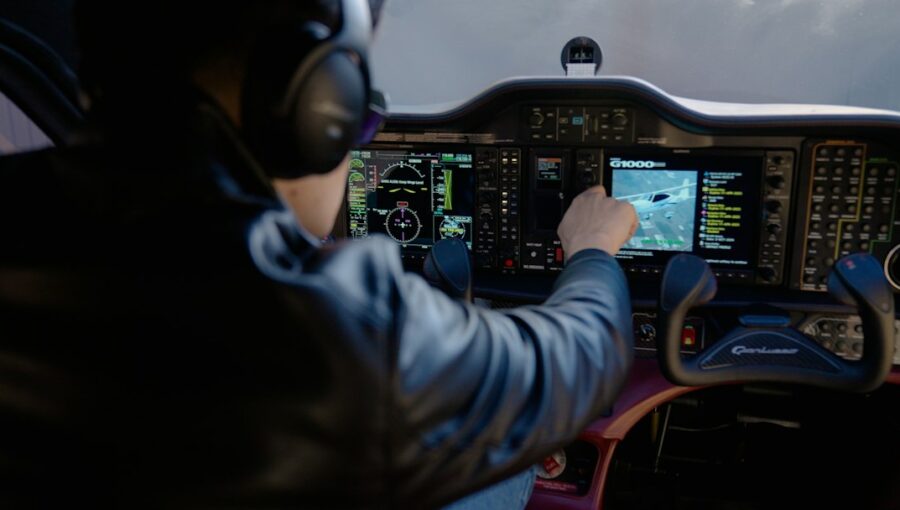
Virtual Reality (VR) is starting to make a significant impact on aviation training, and one of its most compelling benefits is its potential to drastically cut down the costs associated with flight simulators. By offering a highly immersive and interactive training environment, VR can provide many of the essential learning experiences traditionally tied to expensive, hardware-heavy simulators, but at a fraction of the price.
The High Price of Traditional Flight Simulators
For decades, flight simulators have been the bedrock of pilot training. They are indispensable tools for teaching everything from basic handling and emergency procedures to complex navigation and decision-making. However, their Achilles’ heel has always been cost.
The Capital Investment Barrier
Think about what goes into a full-motion flight simulator. These are not just computers; they are massive, complex machines. They involve incredibly sophisticated motion systems that replicate the G-forces and movements of an aircraft. They require high-fidelity visual systems with wide fields of view, often using projectors or multiple screens. The cockpit itself is a faithful replica, down to every switch, dial, and button, often built from actual aircraft parts.
This means a single, high-end simulator can cost anywhere from hundreds of thousands to several million dollars. And that’s just for one. For larger airlines or flight schools, equipping themselves with a fleet of these can represent a colossal capital expenditure, often requiring significant financing or a substantial upfront investment. This barrier to entry can be particularly challenging for smaller training organizations or new entrants into the aviation industry.
The Ongoing Operational Burden
Beyond the initial purchase price, operating these simulators isn’t cheap either. They are power-hungry beasts, consuming significant amounts of electricity to run the motion systems, computers, and visual displays. Maintenance is another major cost. These are intricate electromechanical systems with many moving parts that require regular servicing, calibration, and occasional replacement of components.
Downtime for maintenance also means lost training slots and revenue.
Then there’s the physical space. Simulators, especially full-motion ones, are large. They require dedicated hangars or simulator bays, which often have to be specially constructed with reinforced floors to handle the motion systems. This adds to the real estate costs. Furthermore, these facilities need climate control and security, further contributing to the operational expenses.
Limited Accessibility and Scalability
Because of these high costs, access to advanced simulators can be limited. Pilots might have to travel to specific training centers, incurring travel and accommodation expenses. Scheduling can also be a challenge, with limited slots available, especially during peak training periods. Scaling up training capacity often means investing in more expensive simulator bays, a process that is slow and costly. This lack of accessibility and scalability directly impacts training efficiency and can lead to delays in pilot certification and recurrent training.
Virtual reality (VR) has revolutionized aviation training by providing immersive experiences that significantly reduce the costs associated with traditional flight simulators. By leveraging advanced technology, VR enables pilots to practice critical skills in a risk-free environment, thereby enhancing their readiness for real-world scenarios.
For further insights into the impact of cutting-edge technology on training and performance, you can explore a related article on the capabilities of the Samsung Galaxy Tab S8, which highlights how such devices can enhance learning experiences in various fields, including aviation.
To read more, visit here.
 that presents stereoscopic images to each eye, creating a sense of depth and perspective. Unlike traditional simulators that rely on external screens or projectors, VR places the pilot <em>inside</em> the virtual cockpit. The field of view is typically much wider, covering what you would naturally see if you were actually sitting in the pilot’s seat.</p>
<p>This immersion goes beyond just visuals. Many VR systems incorporate spatial audio, meaning sounds originate from their perceived direction in the virtual environment, further enhancing realism. As VR technology matures, haptic feedback suits and gloves are also becoming more prevalent, allowing trainees to feel virtual controls, vibrations, and even the impact of turbulence, adding another layer of sensory engagement. This holistic immersion helps pilots develop better situational awareness and muscle memory.</p>
<p>Virtual reality is revolutionizing aviation training by providing immersive experiences that significantly reduce flight simulator costs. This innovative approach allows pilots to practice complex maneuvers in a controlled environment without the financial burden of traditional simulators. For those interested in enhancing their training tools, discovering the best free software for voice recording can complement these virtual experiences, enabling better communication and feedback during simulations. You can learn more about this valuable resource in the article found <a href=)
Mimicking Cockpit Environments Realistically
The goal isn’t just to show a pilot a pretty picture; it’s to replicate the functional environment of an aircraft cockpit. High-fidelity VR simulators can accurately model the flight deck of specific aircraft types. This includes the layout of instruments, the functionality of switches and controls, and the overall ergonomics of the space. While current VR HMDs might not perfectly replicate the feel of every physical switch, software interfaces and sometimes even simple physical controls can be integrated to allow for interaction with the virtual environment.
For instance, a pilot can put on a VR headset and see the complete instrument panel of a Boeing 737. They can look around the entire cockpit, interact with virtual buttons and levers using hand controllers, and see the results of their actions displayed on the virtual instruments and outside the virtual windows. This level of interaction is crucial for understanding aircraft systems and developing procedural skills.
The Cost Advantage: A Closer Look
The most significant advantage of VR in aviation training is its cost-effectiveness. Let’s break down why:
- Lower Hardware Costs: A VR training setup typically consists of a powerful PC, a high-quality VR headset, and controllers. While these can still represent an investment, they are orders of magnitude cheaper than a full-motion simulator. A professional-grade VR headset might cost a few thousand dollars, and a capable PC can be acquired for less than $2,000-$3,000. This makes VR systems significantly more accessible for individual pilots, small flight schools, and even larger organizations looking to augment their existing simulator capacity.
- Reduced Physical Footprint: VR doesn’t require dedicated, large simulator bays. A pilot can train in a relatively small space, perhaps a dedicated room or even a corner of an office. This eliminates the need for expensive construction, reinforced flooring, and the associated real estate costs.
- Lower Power Consumption and Maintenance: VR systems are much more energy-efficient than traditional simulators. They don’t have large motion platforms or complex hydraulics to power. Maintenance is also simpler, primarily involving software updates and occasional hardware checks, rather than intricate mechanical repairs.
- Scalability and Portability: The modular nature of VR allows for easy scaling. An organization can start with a few VR stations and add more as needed without a massive infrastructure overhaul. Furthermore, VR systems are portable, meaning training can be brought to different locations or even conducted remotely, reducing travel costs for both instructors and trainees.
Specific Applications of VR in Pilot Training

VR isn’t just a theoretical concept for aviation; it’s actively being implemented and tested for a range of critical training scenarios.
Recurrent Training and Emergency Procedures
One of the most immediate benefits is in recurrent training. Pilots need to undergo regular training to maintain their proficiency, especially in emergency situations. VR can provide a safe and cost-effective way to practice these high-stakes scenarios.
- Engine Failures: Imagine a pilot repeatedly practicing an engine failure scenario during takeoff in VR. They can experience the visual and auditory cues, learn to identify the failed engine, and execute the correct procedures without any real-world risk. The instructor can easily reset the scenario and have the pilot practice again, building confidence and skill.
- System Malfunctions: From electrical failures to hydraulic leaks, VR can simulate a wide array of system malfunctions.
Trainees can learn to diagnose problems, understand the cascading effects of failures, and implement appropriate checklists and procedures. This hands-on (or rather, hands-on-virtual) experience is invaluable for developing troubleshooting skills.
- Adverse Weather Conditions: Simulating challenging weather like severe turbulence, microbursts, or icing conditions is crucial. VR can create these environments vividly, allowing pilots to practice maintaining control of the aircraft and making sound decisions under pressure.
The immersive nature makes the experience much more impactful than simply seeing weather on a screen.
Procedural Training and Cockpit Familiarization
Before even stepping into a real aircraft or a full-flight simulator, pilots can get acquainted with the specific aircraft type
FAQs
What is virtual reality (VR) in aviation training?
Virtual reality in aviation training refers to the use of immersive technology to simulate real-life flight scenarios for training purposes. This technology allows pilots to experience realistic flight conditions in a virtual environment.
How does virtual reality help reduce flight simulator costs?
Virtual reality technology can help reduce flight simulator costs by providing a more cost-effective alternative to traditional flight simulators. VR systems are often more affordable to purchase and maintain, making them a more accessible option for aviation training programs.
What are the benefits of using virtual reality in aviation training?
Some benefits of using virtual reality in aviation training include increased accessibility, cost-effectiveness, enhanced realism, improved engagement, and the ability to customize training scenarios to meet specific learning objectives.
How does immersion enhance the training experience in virtual reality?
Immersion in virtual reality enhances the training experience by creating a more realistic and engaging environment for pilots. By immersing users in a 3D virtual world, VR technology can simulate real-life flight conditions and scenarios, allowing pilots to practice and improve their skills in a safe and controlled setting.
Are there any limitations to using virtual reality in aviation training?
While virtual reality technology offers many benefits for aviation training, there are some limitations to consider, such as potential motion sickness for some users, the need for specialized equipment, and the importance of maintaining a balance between virtual training and hands-on experience in real aircraft.
Enjoying our content? Make us a preferred source on Google:
Add us as a Preferred Source on Google