

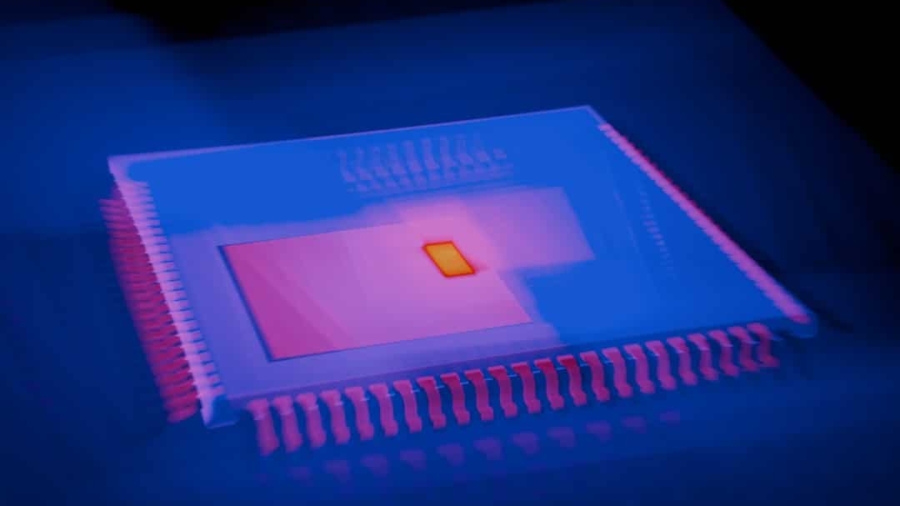
It’s a big question in quantum computing: can photonic quantum processors help us achieve room-temperature quantum systems? The short answer is yes, they show significant promise in this area. While many quantum computing approaches currently require extremely cold temperatures, photonic systems offer a unique path towards warmer, and potentially even room-temperature, operation thanks to the way they encode and manipulate quantum information using light.
Why Room Temperature Matters in Quantum Computing
Beyond the cool factor (pun intended), operating quantum computers at room temperature is a game-changer. Imagine the computing power without the massive infrastructure and energy consumption needed for super-cooling. That’s the dream.
The Cost of Cold
Maintaining near-absolute zero temperatures (millikelvin range) for superconducting qubits and trapped ions is incredibly expensive and complex. We’re talking specialized cryostats, advanced refrigeration systems, and significant ongoing energy costs. This effectively limits the scale and accessibility of these quantum computers.
Practicality and Accessibility
A room-temperature quantum computer could be integrated into existing data centers or even desktop environments more easily.
This opens up possibilities for wider research, development, and eventual practical applications outside of highly specialized labs.
It’s about taking quantum computing from dedicated, highly controlled environments to something more broadly accessible.
Reducing Decoherence
While cold temperatures are often used to reduce environmental noise and thus decoherence in other quantum systems, photonic qubits inherently interact less with their environment. This fundamental difference is what allows them to potentially operate at higher temperatures without sacrificing their quantum properties as much.
In exploring the advancements in photonic quantum processors and their potential for developing room-temperature systems, it is interesting to consider the broader implications of technology in our daily lives. A related article discusses how social media platforms are evolving to accommodate personal identity, highlighting the importance of inclusivity in technology. You can read more about this topic in the article titled “Instagram Adds a Dedicated Spot for Your Pronouns” at this link. This intersection of technology and personal expression reflects the ongoing evolution of systems that prioritize user experience and accessibility.
How Photonic Processors Work at a High Level
At its core, a photonic quantum processor uses photons (particles of light) to carry and process quantum information. Instead of using something like electron spin or superconducting circuits, it’s all about light.
Encoding Information in Photons
Photons can encode quantum information in various properties, such as their polarization (e.
g.
, horizontal or vertical), phase, or even the time at which they arrive. Each of these properties can represent a qubit, a quantum bit.
Manipulating Light for Quantum Operations
Quantum gates, the building blocks of quantum algorithms, are performed by manipulating these photons. This often involves beam splitters to create superpositions, interferometers to induce phase shifts, or detectors to measure the outcomes. It’s like building an optical circuit where photons are guided and transformed.
Detection and Measurement
Finally, single-photon detectors convert the photonic quantum state into a classical signal that can be read out. This measurement collapses the quantum state, providing the result of the quantum computation. The efficiency and accuracy of these detectors are crucial.
The Inherent Room-Temperature Advantage of Photons
This is where photonic quantum processors truly shine in the room-temperature discussion. The very nature of light gives them a leg up.
Weak Interaction with Environment
Photons themselves are bosons and interact very weakly with their environment compared to matter-based qubits. This means they are less susceptible to thermal noise and environmental decoherence, which are the primary reasons other quantum systems need extreme cooling. A photon flying through a vacuum or even glass won’t easily lose its quantum state due to ambient temperature.
No Need for Cryogenic Cooling for Qubits
Unlike superconducting qubits that require cooling to dissipate heat and maintain superconductivity, or trapped ions that need cold environments to reduce their thermal motion, the “qubit” itself (the photon) doesn’t need to be cooled. The information is carried by the photon, and its quantum state is relatively stable at room temperature.
Components Can Be Room-Temperature Compatible
While the photons themselves are robust, the components that generate, guide, manipulate, and detect them also need to be considered. Modern integrated photonics uses materials like silicon nitride or silicon-on-insulator, which perform excellently at room temperature. Lasers operate well at room temperature, and while single-photon detectors can sometimes benefit from cooling to reduce noise, there’s significant progress in developing high-performance, higher-temperature single-photon detectors.
Challenges and Current Limitations
While promising, photonic quantum computing for room-temperature systems isn’t without its hurdles.
Generating Entangled Photons Efficiently
Creating pairs or larger entangled states of photons is still a challenge. Spontaneous parametric down-conversion (SPDC) or spontaneous four-wave mixing (SFWM) are common methods, but they often produce probabilistic entanglement. This means you don’t always get an entangled pair when you try, which can impact the scalability and efficiency of the system. We need more deterministic and higher-rate sources.
Scaling Up and Integration Density
Building large-scale quantum circuits with photons involves integrating many components on a chip. While integrated photonics has made huge strides, achieving the density and complexity required for fault-tolerant quantum computing with millions of qubits is a significant engineering challenge. This includes routing photons without losses and precisely controlling many optical paths simultaneously.
Photon Loss and Detection Efficiency
Photons can be lost during propagation through waveguides or at various interfaces, reducing the number of qubits successfully processed. Furthermore, single-photon detectors, especially those operating at higher temperatures, still have efficiency limitations, meaning they don’t detect every photon that hits them. These losses accumulate and can quickly degrade the overall performance of the quantum computer. Every lost photon is a lost qubit or part of a quantum operation.
Deterministic Single-Photon Sources
While probabilistic sources are used, a truly deterministic single-photon source – one that reliably emits one photon at a time on demand – is crucial for many advanced quantum algorithms and for building more robust quantum computers. Quantum dots are a promising technology for this, but integrating them reliably into photonic circuits at scale remains an active area of research.
The advancements in photonic quantum processors are paving the way for innovative room-temperature systems, which could revolutionize various fields, including computing and telecommunications. A related article discusses the importance of selecting the right technology for executives, emphasizing how the right tools can enhance productivity and decision-making. For more insights on this topic, you can read the article on choosing the best smartphone for chief executives. This connection highlights the broader implications of technology in both personal and professional realms.
Future Outlook and Promising Research Directions
The field is moving fast, and several exciting avenues are being explored to overcome current limitations and realize the full potential of room-temperature photonic quantum computing.
Integrated Photonic Technologies
The strong push towards integrated photonics is a game-changer. By fabricating optical components directly onto chips, we can significantly reduce the size, improve stability, and enable greater scalability. This includes things like:
Silicon Photonics advancements
Silicon-based platforms are well-understood from classical semiconductor manufacturing, offering a pathway to mass production. Developing more complex and lower-loss silicon photonic circuits will be key. This includes better waveguides, couplers, and on-chip active components.
Novel Material Platforms
Beyond silicon, researchers are exploring other materials like silicon nitride, lithium niobate, and even diamond, each offering unique advantages in terms of low loss, nonlinear optical properties, or integration with quantum emitters. These different material systems can offer better performance for specific functions, such as nonlinear operations or low-loss routing.
Advanced Single-Photon Sources and Detectors
Progress in both the generation and detection of single photons is crucial.
Quantum Dots as Deterministic Sources
Quantum dots embedded in photonic waveguides could provide deterministic, high-quality entangled photon sources. The challenge is consistently manufacturing them with uniform properties and integrating them into scalable circuits. Room-temperature operation of these sources is a key goal.
Superconducting Nanowire Single-Photon Detectors (SNSPDs) at Higher Temperatures
While many SNSPDs require cooling, there’s intensive research into materials and designs that could allow them to operate efficiently at higher temperatures, perhaps even thermoelectrically cooled rather than cryogenically. This would drastically reduce the cooling overhead. New detector technologies based on other principles are also being explored.
Hybrid Quantum Systems
Combining photonic processors with other quantum technologies could offer the best of both worlds.
Photons as Quantum Interconnects
Even if “matter” qubits (like superconducting or trapped ions) remain the core computational elements, photons can serve as excellent quantum interconnects, transporting quantum information between different processing nodes or modules that might operate at different temperatures or even in different locations. This could allow for distributed quantum computing where specialized cold systems communicate via room-temperature photon links.
Bridging Photons with Solid-State Qubits
Integrating photonic circuits with solid-state qubits (e.g., color centers in diamond, such as NV centers) that can operate at higher temperatures offers fascinating possibilities. Photons could be used to entangle these solid-state qubits or read out their states, leveraging the strengths of both systems. This could lead to local processing at slightly elevated temperatures coupled with efficient optical communication.
The Long Road Ahead
While photonic quantum processors offer a compelling vision for room-temperature quantum computing, it’s important to be realistic. We’re still in the early stages of development. There are significant engineering and scientific challenges to overcome before we see a standalone, fault-tolerant room-temperature photonic quantum computer. However, the fundamental advantages of photons—their weak environmental interaction and inherent robustness at higher temperatures—make this a highly active and promising area of research. Every advance in integrated photonics, single-photon sources, and detectors brings us closer to this exciting future. The journey is complex, but the potential rewards of accessible, room-temperature quantum computation are enormous.
FAQs
What is a photonic quantum processor?
A photonic quantum processor is a type of quantum computer that uses photons as the basic unit of information processing. It leverages the principles of quantum mechanics to perform complex calculations and solve problems that are currently intractable for classical computers.
How does a photonic quantum processor differ from other types of quantum processors?
Unlike other types of quantum processors, such as superconducting or trapped-ion quantum processors, photonic quantum processors use photons as the quantum bits, or qubits, instead of electrons or ions. This allows for the potential development of room-temperature quantum systems, as photons are less susceptible to environmental interference.
What role do photonic quantum processors play in developing room-temperature systems?
Photonic quantum processors have the potential to enable the development of room-temperature quantum systems due to the inherent properties of photons, such as their resistance to decoherence and their ability to travel long distances without significant loss. This could lead to the creation of more practical and accessible quantum technologies.
What are the potential applications of room-temperature quantum systems enabled by photonic quantum processors?
Room-temperature quantum systems enabled by photonic quantum processors could have a wide range of applications, including secure communication, advanced cryptography, optimized drug discovery, and efficient optimization of complex systems, among others.
What are the current challenges in developing photonic quantum processors for room-temperature systems?
Some of the current challenges in developing photonic quantum processors for room-temperature systems include the need for efficient photon sources, reliable photon detectors, and scalable quantum computing architectures. Additionally, integrating photonic quantum processors with other quantum technologies and overcoming noise and error rates are ongoing areas of research and development.
Enjoying our content? Make us a preferred source on Google:
Add us as a Preferred Source on Google