

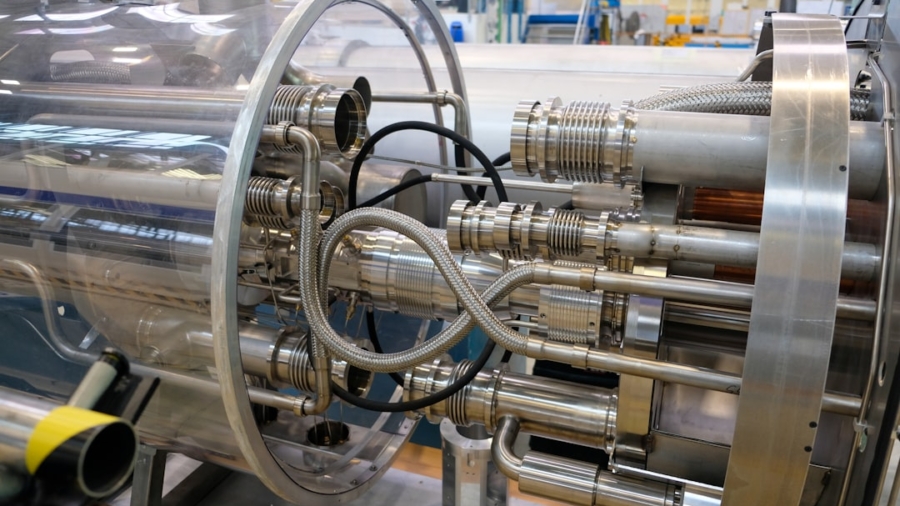
So, you’re wondering if quantum annealing can actually help optimize those sprawling, tangled logistics networks we all deal with. The short answer is yes, potentially. It’s not a magic bullet that will solve everything overnight, but it offers a promising new approach for tackling some of the most complex, intractable optimization problems in logistics today. Think of it as another tool in the toolbox, particularly for situations where classical computing struggles to find optimal solutions in a reasonable timeframe.
The Big Picture: Why Logistics is So Hard
Logistics, even for a relatively small operation, is inherently complex. You’re trying to move things from point A to point B (and C, D, E…) as efficiently as possible, considering a whole host of factors.
The Many Moving Parts
Imagine a delivery company. They’ve got trucks, warehouses, different types of packages, and a ton of customers with varying delivery windows. Each piece of this puzzle interacts with every other piece.
Constraints Everywhere
It’s not just about getting from here to there. You’ve got budget limits, time restrictions, vehicle capacities, driver hours, road closures, and even customer preferences to factor in. These aren’t just suggestions; they’re hard rules. Breaking them means unhappy customers or financial penalties.
Exponential Growth of Choices
As your network grows, the number of possible ways to do things explodes. Adding just one more warehouse or delivery point can turn a manageable problem into one that takes classical computers an impossibly long time to solve, even find a decent approximation. This is where the “optimization problem” really bites. You’re looking for the absolute best solution among an astronomical number of possibilities.
In the realm of advanced computational techniques, quantum annealing has emerged as a powerful tool for optimizing complex logistics networks, significantly enhancing efficiency and reducing operational costs. A related article that explores the intersection of technology and creativity can be found at Unlock Your Creative Potential with the Samsung Galaxy Book Flex2 Alpha, which discusses how innovative devices can facilitate creative problem-solving in various fields, including logistics. This connection highlights the importance of leveraging cutting-edge technology to tackle intricate challenges in logistics optimization.
What Is Quantum Annealing, Anyway?
Before we dive into how it helps logistics, let’s clarify what quantum annealing actually is. It’s not a general-purpose quantum computer designed to break encryption or simulate molecular structures in a broad sense. It’s a specialized type of quantum computer built specifically for solving optimization problems.
Not a Laptop, Not a Supercomputer
Think of it less like a super-powered classical computer and more like a very sophisticated, specialized calculator for a specific kind of math problem. It uses quantum mechanical phenomena, like superposition and tunneling, to explore many possible solutions simultaneously.
The “Energy Landscape” Metaphor
Imagine your optimization problem as a landscape with hills and valleys. The goal is to find the deepest valley – that’s your optimal solution. A classical computer might try to walk down every path, or at least a lot of them. A quantum annealer, through quantum tunneling, can “jump” across hills, potentially finding the deepest valley much faster than by simply walking. It’s like being able to materialize in different areas of the landscape at once to find the lowest point.
How It Finds the “Best” Answer
The annealing process itself involves slowly changing parameters, effectively “cooling” the system. This encourages the quantum bits (qubits) to settle into their lowest energy state, which corresponds to the best solution to your problem. It’s a bit like gently shaking a handful of marbles until they all settle at the lowest point in a bowl.
Applying Quantum Annealing to Logistics Challenges
Now, let’s talk brass tacks. Where does quantum annealing actually fit into logistics? It’s particularly good at problems that can be framed as Quadratic Unconstrained Binary Optimization (QUBO) problems or variations thereof.
Route Optimization and the Traveling Salesperson Problem
This is probably the most obvious application. Imagine a delivery fleet needing to visit hundreds of locations. The Traveling Salesperson Problem (TSP) is a classic example of logistical complexity for this very reason. Finding the shortest or fastest route that visits every point exactly once and returns to the start is incredibly difficult for large numbers of stops.
Dynamic Routing for Fleets
Quantum annealing could, in theory, help optimize routes in real-time or near real-time, adapting to unexpected events like traffic jams or sudden order changes. Instead of recalculating from scratch, it might be able to incorporate new constraints and quickly find an updated optimal path. This could save significant fuel costs and delivery times.
Multi-Depot, Multi-Vehicle Scenarios
Beyond a single truck, what about coordinating an entire fleet from multiple depots, each with different vehicle types and capacities, serving various regions? This escalates the complexity dramatically. Quantum annealing could help assign vehicles to routes and optimize those routes simultaneously.
Warehouse Placement and Inventory Management
Deciding where to put a new warehouse or distribution center is a huge, long-term strategic decision. It impacts everything from transportation costs to delivery times.
Strategic Location Planning
You’re trying to find the optimal location for a new facility that minimizes total transportation costs to serve a set of customer locations, taking into account current facilities and potential future growth. This involves balancing costs, customer proximity, and capacity. Quantum annealing could be used to evaluate many potential site combinations and identify the most cost-effective long-term solution.
Dynamic Inventory Rebalancing
Imagine a network of warehouses, and you need to shift inventory around to meet fluctuating demand or avoid stockouts. This isn’t just about moving goods; it’s about optimizing the flow of those goods across the network, considering transport costs, storage capacities, and demand forecasts. Quantum annealing could help decide what to move, when, and where.
Supply Chain Resilience and Risk Mitigation
Modern supply chains are global and often fragile. Disruptions, whether from natural disasters, political events, or supplier failures, can have massive ripple effects.
Identifying Bottlenecks and Single Points of Failure
Quantum annealing could be used to analyze large, interconnected supply chains to pinpoint critical nodes or links whose failure would cause the most disruption. By modeling the chain as a complex network, it could help identify vulnerabilities that might be hard to spot with classical methods.
Optimal Diversification Strategies
Given the risk of disruption, how do you best diversify your suppliers or manufacturing sites to minimize impact? This is another optimization problem. Quantum annealing could help explore various diversification strategies, considering cost, lead times, and risk profiles, to find the most resilient configuration.
The Current Reality: Where Are We Now?
It’s important to set realistic expectations. Quantum annealing isn’t going to replace all your existing logistics software tomorrow. We’re still in the early stages.
Hardware Limitations
Current quantum annealers, like those developed by D-Wave, have a limited number of qubits. While this number is growing, it’s not yet large enough to tackle every real-world logistics problem directly. Real-world problems often need to be broken down into smaller chunks, which adds complexity.
Qubit Connectivity
It’s not just about the number of qubits; it’s also about how they’re interconnected. Not all qubits can interact directly with all other qubits, which can make mapping complex problems onto the quantum annealing hardware challenging.
Noise and Error Rates
Quantum systems are delicate. They are susceptible to noise, which can introduce errors into the computation. While error correction and mitigation techniques are improving, it’s still a factor that impacts the reliability of the results.
Problem Formulation is Key
The biggest hurdle for many practical applications isn’t always the quantum annealer itself, but the challenge of translating a real-world logistics problem into the specific mathematical format (like a QUBO) that the annealer can understand. This involves a lot of creativity and expertise in mathematical modeling.
Bridging the Gap from Business to Math
You need domain experts who understand logistics, and quantum experts who understand how to translate that into a QUBO problem. This translation, known as “problem embedding,” is a non-trivial step and often requires significant effort.
Computational Cost of Embedding
Sometimes, the classical preprocessing required to embed a problem onto the quantum annealer can itself be computationally intensive. This is another area where research is ongoing to simplify and automate the process.
Hybrid Approaches: The Most Promising Path
For the foreseeable future, the most practical approach is likely “hybrid quantum-classical computing.” This means using quantum annealers for the parts of the problem they excel at (the most complex combinatorial optimization bits) and classical computers for everything else.
Splitting the Workload
Imagine you have a huge logistics problem. You might use classical algorithms to narrow down the possibilities or pre-process data. Then, you feed the truly intractable core optimization problem to the quantum annealer. The results from the annealer are then fed back to the classical system for further refinement or integration into larger solutions.
Augmenting, Not Replacing
This isn’t about replacing classical computing; it’s about augmenting it. Quantum annealers can act as powerful accelerators for specific, hard-to-solve components of a larger classical optimization workflow.
In exploring the advancements in quantum computing, particularly in the realm of logistics optimization, a fascinating article discusses how quantum annealing can significantly enhance the efficiency of complex logistics networks. This innovative approach leverages the principles of quantum mechanics to solve intricate optimization problems that traditional methods struggle with. For those interested in the intersection of technology and logistics, the article provides valuable insights and can be found here: unlock the possibilities with Samsung Galaxy S22.
The Future: What to Expect Next
Despite the current limitations, the potential of quantum annealing for logistics is significant, and the field is advancing rapidly.
Increased Qubit Count and Connectivity
As hardware continues to improve, annealers will become more powerful, capable of handling larger and more complex problems directly, without as much reliance on decomposition.
New Annealing Architectures
Beyond D-Wave, other companies and research institutions are exploring different quantum annealing hardware architectures, each with its own strengths and weaknesses. Competition and innovation in this space will drive progress.
Better Problem Formulation Tools
Software tools and frameworks designed to simplify the translation of real-world problems into quantum annealing compatible formats are continuously being developed. This will make it easier for domain experts, who aren’t quantum physicists, to leverage this technology.
Libraries and APIs
Expect to see more user-friendly libraries and APIs that abstract away much of the underlying quantum mechanics, allowing logistics professionals to focus on defining their optimization problems.
Broader Industry Adoption and Proofs of Concept
As more companies experiment with quantum annealing and demonstrate tangible benefits in specific use cases, we’ll see a snowball effect. Early adopters gaining a competitive edge will push others to explore the technology.
Collaborative Research
Expect more collaborations between quantum computing companies, logistics firms, and academic institutions to push the boundaries of what’s possible and identify new challenging problems where quantum annealing can provide a differentiating advantage.
Specialized Services and Consultants
As the field matures, we’ll likely see the emergence of specialized consulting services focused on helping logistics companies identify and implement quantum annealing solutions.
In conclusion, quantum annealing isn’t a silver bullet, but it’s a powerful and specialized tool emerging at a time when logistics networks are becoming incredibly complex. For organizations dealing with truly massive, dynamic, and constraint-heavy optimization problems, it offers a novel approach that could eventually unlock efficiencies and resilience simply not achievable with classical methods alone. The journey is just beginning, but the destination holds significant promise for the future of logistics.
FAQs
What is quantum annealing?
Quantum annealing is a computational technique that leverages the principles of quantum mechanics to solve optimization problems. It involves finding the lowest energy state of a system, which corresponds to the optimal solution of the problem being solved.
How does quantum annealing optimize complex logistics networks?
Quantum annealing can be used to optimize complex logistics networks by efficiently solving large-scale combinatorial optimization problems. This includes tasks such as route optimization, inventory management, and supply chain planning, which are critical for improving the efficiency and cost-effectiveness of logistics operations.
What are the advantages of using quantum annealing for logistics optimization?
Quantum annealing offers the potential for significant speedup in solving complex optimization problems compared to classical computing methods. This can lead to more accurate and efficient solutions for logistics networks, ultimately improving operational performance and reducing costs.
Are there any limitations or challenges associated with quantum annealing for logistics optimization?
While quantum annealing shows promise for logistics optimization, there are challenges such as hardware limitations, error rates, and the need for specialized expertise in quantum computing. Additionally, the technology is still in its early stages and may not yet be suitable for all logistics optimization tasks.
What is the current state of quantum annealing technology for logistics optimization?
Quantum annealing technology is actively being researched and developed for logistics optimization applications. Companies and research institutions are exploring its potential and working to overcome technical challenges to make quantum annealing a practical tool for improving complex logistics networks.
Enjoying our content? Make us a preferred source on Google:
Add us as a Preferred Source on Google