

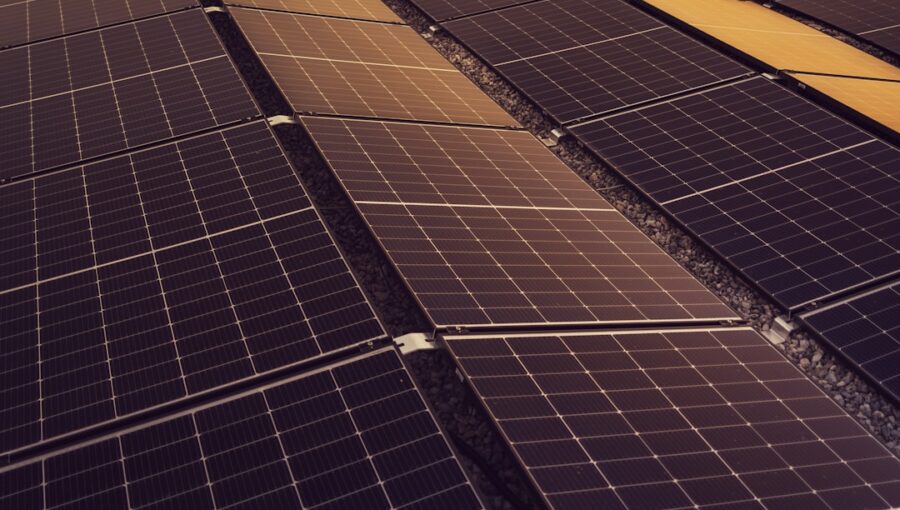
So, what’s the big deal with perovskite tandem solar cells and why are they so important for the future of clean energy? In a nutshell, they’re a promising new technology that stacks different types of solar cells on top of each other to capture more of the sun’s energy than traditional solar panels can. This means more power from the same amount of space, which is a game-changer for making solar energy even more accessible and effective.
Most of the solar panels you see on rooftops today are what we call “single-junction” solar cells. Think of them like a one-trick pony. They’re really good at absorbing a specific range of sunlight wavelengths, but they miss out on a whole lot of the sun’s energy that falls outside that sweet spot.
The Physics of Light Absorption
Sunlight isn’t just one color; it’s a whole spectrum of different wavelengths. Silicon, the material most commonly used in solar cells, is excellent at converting visible light into electricity. However, it’s not as efficient at capturing the higher-energy ultraviolet light or the lower-energy infrared light. This means a significant portion of the incoming solar energy is simply lost, either passing through the silicon or being converted into heat, which we don’t want.
Efficiency Limits: The Theoretical Ceiling
Because of this limitation, single-junction silicon solar cells have a theoretical efficiency limit. While we’ve gotten remarkably good at pushing this limit higher through manufacturing advancements, there’s a fundamental physical ceiling. This plateau means that even with perfect manufacturing, we can’t expect current silicon technology to get much more efficient. To truly unlock the next level of solar power generation, we need a different approach.
Perovskite tandem solar cells represent a significant advancement in the quest for efficient and sustainable energy solutions, as highlighted in the article on boosting efficiency in next-gen clean energy hardware. For those interested in exploring how innovative technology can enhance everyday devices, a related article discusses the potential of the Samsung Galaxy Chromebook 2 360, showcasing how advancements in technology can lead to new possibilities in various fields. You can read more about it here: