

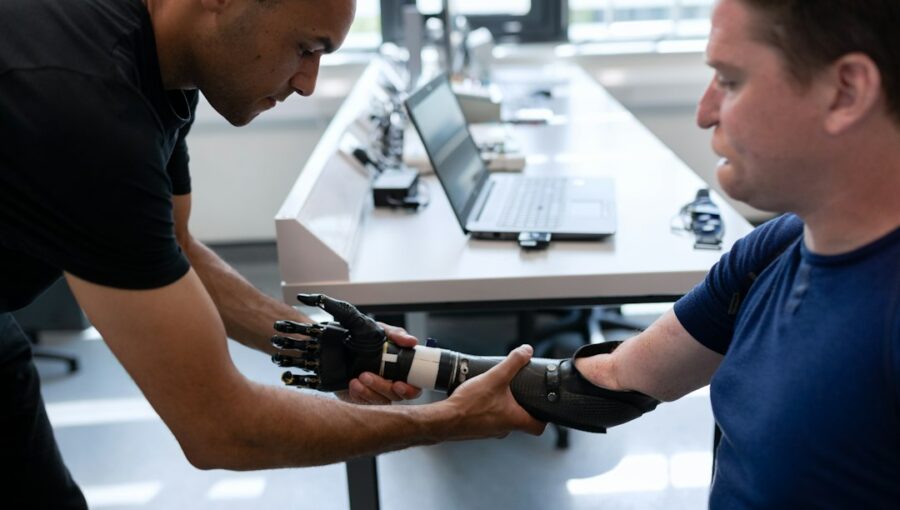
Smarter Limbs: How Myoelectric Sensors and Targeted Muscle Reinnervation Are Changing Prosthetics
Alright, let’s talk about prosthetic limbs. For a long time, they were pretty basic – hooks, passive hands, things like that. But lately, thanks to some seriously clever engineering and surgical advances, we’re seeing prosthetics that are a whole lot more intuitive and functional. The big game-changers? Myoelectric sensors and Targeted Muscle Reinnervation (TMR). These two technologies, often working hand-in-hand, are letting amputees control their prosthetic limbs with their minds, or at least with the electrical signals from their remaining muscles, in a way that feels much more natural than ever before. It’s a huge leap forward, giving people a level of control and dexterity that was once the stuff of science fiction.
In exploring the advancements in next-generation prosthetics, particularly the integration of myoelectric sensors and targeted muscle reinnervation, it is fascinating to consider how technology is evolving across various fields. For instance, a related article discusses the latest innovations in consumer electronics, which can also impact the development of prosthetic devices. You can read more about this in the article on choosing the right iPhone for you in 2023, which highlights the importance of selecting technology that enhances user experience and functionality. For more information, visit this link.
Key Takeaways
- The training data includes information and events up to October 2023.
- Insights and knowledge are based on a wide range of sources available until the cutoff date.
- No updates or developments occurring after October 2023 are included in the training.
- Users should verify current information from reliable sources for the latest updates.
- The model’s responses reflect the context and knowledge available up to the specified date.
The Foundations of Next-Gen Control

To really get what makes these new prosthetics so exciting, it helps to understand the underlying principles. We’re essentially bridging the gap between biological signals and mechanical movement, making the prosthetic an extension of the person, not just a tool they strap on.
Understanding Myoelectric Signals
So, how do you control a prosthetic with your thoughts? Well, it’s not quite telekinesis, but it’s close. When you decide to move a muscle, your brain sends electrical signals down your nerves. These nerves then tell your muscles to contract. This muscle contraction generates tiny electrical impulses, called myoelectric signals. Think of them as the electrical chatter of your muscles.
Traditional prosthetics often relied on switches or mechanical movements to control grip or elbow flexion. Myoelectric prosthetics, however, pick up on these natural electrical signals from residual muscles in the limb stump. Sensors placed on the skin over these muscles detect these signals. When a user thinks about clenching their hand, for example, the remaining muscles in their forearm might subtly tense. The myoelectric sensors pick up on this electrical activity, and that signal is then interpreted by the prosthetic’s computer to tell the prosthetic hand to close. It’s a direct, intuitive way to control movement without requiring conscious thought about operating a separate switch.
Limitations of Traditional Myoelectric Control
While a big improvement over purely mechanical prostheses, early myoelectric systems weren’t perfect. One of the main hurdles was distinguishing between different commands. Imagine you have only a couple of muscle sites available in your residual limb. You might use one muscle to close the hand and another to open it. But what if you want to rotate the wrist, or articulate individual fingers? You quickly run out of distinct muscle signals to map to all those different movements.
This often led to a limited range of motion, awkward control patterns, and users having to perform complex, often compensatory muscle contractions to achieve simple tasks.
For example, some systems required “co-contraction” – tensing two muscles at once – to switch between different control modes, which could be fatiguing and unnatural. It was better than nothing, but still a long way from seamless, natural limb function. This is where TMR really steps in to elevate the game.
Targeted Muscle Reinnervation (TMR) Explained

This is where things get really clever, blending surgery with engineering to create a more sophisticated control interface. TMR is a surgical procedure that essentially reroutes nerves that once controlled the lost limb, giving them new “homes” in different, healthy muscles.
The Surgical Process
During a TMR procedure, a surgeon identifies the nerves in the residual limb that used to control the intricate movements of the hand or arm. These nerves, though no longer connected to their original muscles, still carry the electrical signals from the brain.
The surgeon then carefully dissects these nerves and grafts them onto tiny, denervated (meaning their original nerve supply has been cut) segments of healthy, often less-used muscles in the residual limb or even in a nearby area like the chest.
Over several months, these rerouted nerves grow into their new muscle targets. As they do, they re-establish a connection, and when the patient thinks about moving their missing hand or fingers, these newly reinnervated muscles will subtly contract. The key here is that these contractions are often more distinct and robust than what could be achieved with the original, often atrophied, muscles in a typical residual limb.
Advantages of TMR for Prosthetic Control
The benefits of TMR are pretty significant.
Firstly, it provides more independent control sites. Instead of just one or two general muscle groups, TMR can create several distinct control signals. For instance, nerves that once controlled individual fingers can be rerouted to different small patches of muscle, allowing for more granular control of a multi-articulating prosthetic hand.
Secondly, the signals produced by these reinnervated muscles are often stronger and more clearly defined.
Because the nerves are directly stimulating a muscle, the resulting myoelectric signal is robust and easier for the prosthetic’s sensors to detect and interpret. This leads to more reliable and precise prosthetic control.
Thirdly, and perhaps most importantly, TMR makes prosthetic control more intuitive. When a patient thinks “close my hand,” the reinnervated muscle that now responds to that command generates a signal.
This direct mental command-to-muscle activation feels much more natural than trying to learn a complex sequence of co-contractions. It reduces the cognitive load and makes using the prosthetic less effortful and more seamless. Users often describe it as feeling like they are moving their own hand, even though it’s a prosthetic.
Beyond Motor Control: Sensory Feedback
While TMR’s primary focus has been motor control, there’s a fascinating side benefit: sensory feedback.
Sometimes, patients who undergo TMR report feeling sensations – pressure, temperature, even a phantom “grip” – localized to the area of the reinnervated muscle when the prosthetic interacts with an object. This phenomenon, known as “referred sensation,” occurs because the brain is still wired to interpret signals from those rerouted nerves as coming from the missing limb.
Researchers are actively exploring ways to leverage this. Imagine a prosthetic hand with sensors that detect pressure.
If these sensors could stimulate the skin over the reinnervated muscle, the brain might interpret that stimulation as feeling what the prosthetic is touching. This kind of “biofeedback” could dramatically improve the utility and perception of the prosthetic, making it feel even more like a part of the body. It’s a complex area, but the potential is huge for bringing back some sense of touch.
Integrating TMR and Advanced Myoelectric Systems
This is where the magic really happens – when TMR and sophisticated myoelectric sensors and algorithms are combined. It’s not just about having more control signals; it’s about how those signals are interpreted and used.
High-Density Myoelectric Sensors
Traditional myoelectric sensors are often just a couple of electrodes placed on the skin. With TMR, you’ve got more distinct muscle sites, and to really capture their individual signals, we’re seeing the development of high-density myoelectric sensor arrays.
These arrays use many more electrodes – sometimes dozens – packed closely together. Think of it like going from a single microphone to a multi-microphone setup that can pick up sounds from different directions with much greater detail. These dense arrays can precisely localize and differentiate the electrical activity from each reinnervated muscle patch. This means clearer, more nuanced signals are fed into the prosthetic’s control system. The result is a much richer dataset for the prosthetic to work with, allowing for more precise and complex movements.
Machine Learning and Pattern Recognition
Having more and clearer signals is great, but how does the prosthetic “understand” what those signals mean? This is where machine learning and advanced pattern recognition algorithms come into play. Instead of simply mapping one muscle contraction to one movement (e.g., biceps contract = elbow flex), these algorithms learn complex patterns of muscle activity.
When a person with TMR thinks about, say, making a “peace sign” with their prosthetic hand, a very specific pattern of electrical activity will occur across several of their reinnervated muscles. The machine learning algorithm is trained to recognize that specific pattern and associate it with the “peace sign” command. This training process involves the user repeatedly performing various intended movements while the system “listens” to their muscle signals.
Over time, the algorithm gets better and better at distinguishing subtle differences in muscle activation patterns. This allows for more degrees of freedom in prosthetic control – independent finger movements, wrist rotation, and even simultaneous movements, all controlled intuitively by the user’s natural intentions. It’s a continuous learning process, with the system adapting to the user’s unique muscle activation patterns.
Real-Time Feedback and Adaptation
For a prosthetic to feel truly natural, it needs to respond instantly and consistently. The integration of TMR and advanced myoelectric systems aims for real-time feedback and adaptation. As the user performs a movement, the sensors pick up the signals, the algorithms interpret them, and the prosthetic responds almost instantaneously.
But it’s not just a one-way street. Researchers are also exploring ways to incorporate sensory feedback from the prosthetic back to the user. Imagine pressure sensors in the prosthetic fingertips that, when activated, could stimulate the skin over the reinnervated muscles. This could provide a rudimentary sense of touch, allowing the user to feel how firmly they are grasping an object, or its texture. This kind of biofeedback loop is crucial for fine motor control and for making the prosthetic feel like an integral part of the body. The goal is a seamless, intuitive interaction where the user feels they are directly controlling the limb, not just operating a device.
Next-generation prosthetics are revolutionizing the field of assistive technology, particularly through the integration of myoelectric sensors and targeted muscle reinnervation. These advancements allow for more intuitive control of prosthetic limbs, significantly improving the quality of life for amputees. For those interested in exploring how technology is shaping our daily lives, a related article on smartwatches provides insight into the latest innovations in wearable devices. You can read more about it in this review of Huawei smartwatches, which highlights how these gadgets are becoming increasingly sophisticated and user-friendly.
The Impact on Users and Daily Life
| Metric | Description | Value / Range | Unit | Notes |
|---|---|---|---|---|
| Myoelectric Sensor Sensitivity | Ability of sensors to detect muscle electrical signals | 0.1 – 5 | mV | Lower values indicate higher sensitivity |
| Targeted Muscle Reinnervation (TMR) Success Rate | Percentage of patients achieving functional reinnervation | 85 – 95 | % | Measured 6-12 months post-surgery |
| Prosthetic Control Accuracy | Accuracy of prosthetic movement control via myoelectric signals | 90 – 98 | % | Based on task completion tests |
| Response Time | Time delay between muscle signal and prosthetic movement | 50 – 150 | ms | Lower values improve user experience |
| Battery Life | Operational time of prosthetic device on a single charge | 8 – 16 | hours | Depends on sensor and actuator usage |
| Degrees of Freedom (DoF) | Number of independent movements controlled | 5 – 7 | DoF | Higher DoF allows more natural movement |
| Weight of Prosthetic Limb | Overall weight of the prosthetic device | 1.2 – 2.5 | kg | Lightweight designs improve comfort |
| Training Time | Time required for user to effectively control prosthetic | 4 – 12 | weeks | Varies by individual and system complexity |
This shift in prosthetic technology isn’t just a technical achievement; it has profound implications for the individuals who use these limbs every day. It’s about moving from basic utility to enhanced capability and quality of life.
Enhanced Dexterity and Functionality
One of the most immediate impacts is the significant improvement in dexterity and overall functionality. With more independent control sites and intuitive pattern recognition, users can perform a wider range of tasks with greater precision. Simple actions like picking up small objects, manipulating tools, or even tying shoelaces become much more feasible.
Consider a multi-articulating prosthetic hand. Before TMR and advanced myoelectrics, operating such a hand might involve awkward button presses or complex co-contractions to switch modes. Now, a user can often command individual finger movements or grasp patterns by simply thinking about those actions. This makes the prosthetic less of a cumbersome tool and more of a functional extension, opening up new possibilities for personal independence and even returning to certain professions or hobbies.
Reduced Cognitive Load and Fatigue
Traditional myoelectric prosthetics, with their limited control schemes, often required significant cognitive effort. Users had to constantly think about how to activate specific muscles or sequences to achieve a desired movement. This “cognitive load” could be mentally fatiguing and make prolonged use challenging.
TMR, by providing a more natural and intuitive control interface, drastically reduces this cognitive burden. Because the nerve signals are routed in a way that aligns with the brain’s original motor maps, the act of controlling the prosthetic feels more like moving a natural limb. This means less conscious effort is needed, reducing mental fatigue and allowing users to engage with their surroundings more naturally. They can focus on the task at hand rather than on operating the prosthetic.
Psychological and Social Benefits
Beyond the practical improvements, the psychological and social benefits are substantial. For many amputees, the ability to regain a higher level of function and control can significantly boost self-confidence and body image. The prosthetic feels more integrated, more “their own.”
The improved dexterity can also lead to greater independence in daily living, reducing reliance on others for basic tasks.
This sense of autonomy is incredibly important.
Furthermore, the more natural movements and appearance of advanced prosthetics can reduce the social stigma sometimes associated with traditional prostheses, fostering greater acceptance and interaction in social settings. It’s about feeling more whole and capable, which impacts every aspect of life.
Next-generation prosthetics are revolutionizing the field of rehabilitation by integrating myoelectric sensors and targeted muscle reinnervation, which significantly enhance the functionality and control of artificial limbs. For those interested in the latest advancements in technology, a related article discusses the innovative features of the iPhone 14 Pro, showcasing how modern devices are continually evolving to improve user experience. You can read more about it in this insightful piece on the iPhone 14 Pro. This intersection of technology and healthcare highlights the potential for future developments in both fields.
The Road Ahead: Challenges and Future Directions
While current advancements are exciting, the journey to truly seamless, bio-integrated prosthetics is far from over. There are still significant challenges to overcome and thrilling new avenues of research being explored.
Cost and Accessibility
One of the most pressing issues is the cost. Advanced prosthetic limbs, especially those incorporating TMR and sophisticated myoelectric systems, are incredibly expensive. This often puts them out of reach for many individuals, particularly in regions with limited healthcare resources or insurance coverage. Making these life-changing technologies more affordable and widely accessible is a critical challenge that requires innovation in manufacturing, material science, and healthcare policy.
Beyond the initial cost, maintenance, repairs, and regular upgrades also contribute to the financial burden. For these prosthetics to truly transform lives on a broad scale, their accessibility must improve dramatically.
Durability and Maintenance
These highly advanced prosthetics contain complex electronics, delicate sensors, and intricate mechanical components. While designs are improving, they are still susceptible to wear and tear, especially with daily use in various environments. Water, dust, impacts – all can compromise functionality.
Ensuring the long-term durability of these devices, while maintaining their lightweight and functional characteristics, is an ongoing engineering challenge. Additionally, routine maintenance, software updates, and potential repairs can be complex and require specialized technicians, adding to the practical considerations for users.
Advanced Sensory Feedback Integration
As mentioned earlier, bringing meaningful sensory feedback to users is a holy grail in prosthetics research. While referred sensation from TMR is a good start, researchers are working on more direct and nuanced methods. This includes developing haptic feedback systems that can simulate different textures or pressures, and even direct neural interfaces that could stimulate nerves directly to create highly realistic sensations.
The goal is to provide a rich tapestry of sensory information – touch, temperature, proprioception (awareness of limb position) – that would allow users to interact with the world with even greater confidence and finesse, further blurring the line between biological and artificial limbs.
Direct Neural Interfaces
Looking further into the future, the ultimate goal for prosthetic control and feedback might lie in direct neural interfaces. Instead of relying on muscle signals (myoelectric), these systems would directly tap into the nerves or even the brain itself. This could involve implanting microelectrodes directly into residual nerves or even the motor cortex of the brain.
Such interfaces could provide an even more granular level of control, potentially allowing for thought-controlled movement without any muscle activation. Conversely, they could also provide direct sensory feedback to the brain, creating truly immersive and realistic sensations. This field, often called brain-computer interfaces (BCIs), is still in its early stages for prosthetic control but holds immense promise for the coming decades, offering the potential for unparalleled integration and natural function. While significant ethical and technical hurdles remain, the research is intensely active and holds the promise of an even more seamless future.
FAQs
What are myoelectric sensors?
Myoelectric sensors are devices that detect and measure the electrical activity produced by muscles. They are commonly used in prosthetics to enable users to control their artificial limbs using muscle signals.
How do myoelectric sensors improve prosthetic functionality?
Myoelectric sensors allow for more intuitive and precise control of prosthetic devices by translating muscle signals into specific movements. This results in increased dexterity and natural movement for the user.
What is targeted muscle reinnervation (TMR) and how does it work?
Targeted muscle reinnervation is a surgical procedure where the nerves that previously controlled an amputated limb are rerouted to remaining muscles. This allows for more natural control of prosthetic devices and can help reduce phantom limb pain.
How does the integration of myoelectric sensors and TMR benefit prosthetic users?
By combining myoelectric sensors with targeted muscle reinnervation, prosthetic users can experience improved control over their artificial limbs. This integration allows for more precise movements and a greater range of motion, enhancing the overall functionality and usability of the prosthetic.
Are there any limitations or challenges associated with next-generation prosthetics using myoelectric sensors and TMR?
Some limitations include the need for specialized training to effectively use these advanced prosthetic systems, as well as the cost of the technology. Additionally, individual variations in muscle signals and nerve reinnervation outcomes can impact the success of the integration.
Enjoying our content? Make us a preferred source on Google:
Add us as a Preferred Source on Google