

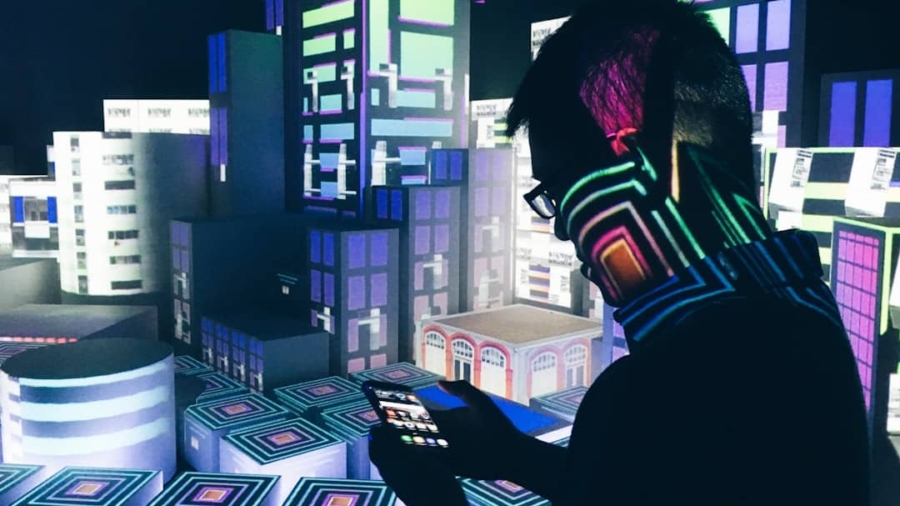
Spatial computing is changing how we work together, and it’s doing so much more than just virtual reality.
Think of it as blending our digital world seamlessly with our physical one, allowing us to interact with digital content in 3D space, not just on a flat screen.
This isn’t just about putting on a headset and pretending to be in a meeting; it’s about making our real workspaces smarter and more interactive, and creating entirely new ways for teams to connect, share, and build.
For a long time, “collaboration in the metaverse” conjured images of cartoon avatars in VR meeting rooms. While VR has its place, spatial computing takes a more holistic approach. It’s about leveraging augmented reality (AR), mixed reality (MR), and the internet of things (IoT) to weave digital information directly into our physical environments. This creates a multi-layered workspace where digital assets aren’t just viewed, but actively inhabited and manipulated within our real-world settings.
What’s the Difference Anyway?
It’s easy to get these terms muddled, so let’s quickly clarify.
- Virtual Reality (VR): Completely immerses you in a simulated environment, blocking out the real world. Think gaming headsets.
- Augmented Reality (AR): Overlays digital information onto your real-world view, enhancing it. Think Snapchat filters or Pokémon Go.
- Mixed Reality (MR): Blends real and virtual worlds, allowing digital objects to interact with physical ones and vice-versa. This is where spatial computing really shines.
- Spatial Computing: The overarching concept that encompasses AR, MR, and often VR, focusing on how we interact with and manipulate digital information within real-world 3D space.
The key takeaway is that spatial computing isn’t just an isolated headset experience; it’s an ecosystem that enhances existing physical spaces and creates new, hybrid ones.
In exploring the transformative impact of spatial computing on collaborative workspaces, it’s interesting to consider how digital assets are evolving alongside these technologies. A related article that delves into the intersection of digital innovation and art is available at What is NFT Image?. This piece discusses the rise of non-fungible tokens (NFTs) and their implications for ownership and collaboration in the digital realm, highlighting how these concepts can complement the advancements in spatial computing and redefine the way we interact in virtual environments.
Key Takeaways
- Clear communication is essential for effective teamwork
- Active listening is crucial for understanding team members’ perspectives
- Conflict resolution skills are necessary for managing disagreements
- Trust and respect are the foundation of a successful team
- Collaboration and cooperation are key for achieving common goals
Hands-On Interaction: Making Digital Tangible
One of the most compelling aspects of spatial computing is how it transforms interaction. No longer are we tied to keyboards and mice to manipulate digital content. We can gesture, touch, and even walk around virtual objects that appear to exist in our physical space. This natural interface fosters a much more intuitive and engaging collaborative experience.
Collaborative 3D Design and Prototyping
Imagine a team of engineers working on a new product. Instead of sharing flat schematics or 2D CAD files, they can project a full-scale 3D model of their design directly into their actual workshop.
They can then walk around it, point out specific components, and even virtually interact with different parts – all while seeing each other and maintaining real-world communication.
- Shared Perspectives: Everyone sees the same 3D model from their unique physical viewpoint, allowing for in-depth discussion and problem-solving without the ambiguity of interpreting 2D drawings.
- Iterative Design in Real-Time: Changes made by one team member can be instantly reflected in the shared spatial model, facilitating rapid iteration and feedback cycles.
- Contextual Feedback: Engineers can highlight issues or suggest improvements directly onto the virtual model, anchoring their feedback to the specific design element.
- Pre-visualization for Clients: Clients can “experience” a product or architectural design before it’s built, understand its scale and functionality, and provide early feedback.
This method significantly cuts down on misunderstanding and streamlines the design process, making it far more efficient than traditional screen-based collaboration.
Training and Onboarding with a Twist
Traditional training often involves manuals, videos, or simulators that lack real-world context. Spatial computing changes this by bringing digital instruction directly into the operational environment.
- Overlaying Instructions: Workers can wear AR glasses that project step-by-step instructions directly onto machinery or complex equipment as they perform tasks. This reduces errors and speeds up the learning curve, especially for intricate procedures.
- Interactive Simulations in Place: Instead of a separate simulator room, trainees can practice complex assembly or maintenance tasks right on the factory floor, with digital guides demonstrating procedures.
- Remote Expert Assistance: A seasoned expert located elsewhere can “see” what a field technician is seeing through their AR glasses, draw annotations onto their view, and guide them through troubleshooting or repair.
This kind of in-context learning is far more effective than abstract training methods, leading to higher retention and greater operational efficiency.
Breaking Down Silos: Connecting Distributed Teams Virtually

The rise of remote and hybrid work models has made effective collaboration across geographical distances more critical than ever. Spatial computing offers sophisticated solutions that go beyond simple video conferencing, creating a stronger sense of shared space and presence.
Persistent Shared Digital Spaces
Unlike a video call that disappears when you hang up, spatial computing allows for the creation of persistent digital workspaces. These are virtual environments that can be accessed by team members from anywhere, at any time, allowing them to pick up exactly where they left off.
- Virtual Project Rooms: Imagine a dedicated digital “project room” filled with 3D models, data visualizations, digital whiteboards, and documents, all spatially organized.
Team members can enter this room, interact with the content, and leave notes for colleagues to find later.
- Asynchronous Collaboration: This persistence supports asynchronous work, where team members in different time zones can contribute to the shared digital space at their convenience, knowing their input will be visible and integrated.
- Digital Twins for Remote Operations: For industries like manufacturing or infrastructure, a “digital twin” of a physical asset can be created in a persistent spatial environment. Remote teams can monitor, analyze, and even collaborate on maintaining these assets as if they were physically present.
These persistent spaces foster continuity and a shared sense of progress, even when team members are geographically dispersed.
Enhanced Remote Presence and Communication
While video conferencing connects us visually, spatial computing aims to bridge the gap in terms of actual presence and interaction.
- Holographic Presence: Advanced spatial computing systems are moving towards “holographic” communication, where 3D representations of remote colleagues can appear in your physical space, allowing for more natural eye contact and body language interactions than flat video feeds.
- Shared Pointers and Gaze Tracking: In a shared spatial environment, you can see where your colleague is looking or pointing, making it much easier to direct attention and convey complex ideas without ambiguity.
- Environmental Context Sharing: Sharing spatial context means remote collaborators can better understand the physical environment in which their colleagues are working, leading to more informed and relevant contributions.
This moves beyond just “seeing” someone to “being with” someone in a shared digital and physical context, significantly enhancing communication depth.
Data Visualization and Decision-Making in 3D

Making sense of vast amounts of data is a constant challenge for businesses. Spatial computing offers a powerful new paradigm for data visualization, allowing teams to literally step inside their data and explore it in intuitive, immersive ways.
Immersive Data Exploration
Instead of poring over spreadsheets or flat dashboards, imagine interacting with financial trends, sales figures, or scientific data as 3D structures that you can walk around, manipulate, and analyze from different angles.
- Understanding Complex Relationships: When data points are rendered spatially, it becomes easier to identify patterns, outliers, and correlations that might be hidden in traditional 2D representations.
- Collaborative Data Slicing: A sales team could project regional sales data onto a 3D map, filter by product line, and collectively identify underperforming areas or emerging trends by manipulating the virtual data visualization.
- Scientific Research: Researchers can visualize complex molecular structures, weather patterns, or astronomical data in 3D, leading to new insights and discoveries.
This shift helps teams to collectively grasp complex information more quickly and make more informed decisions.
Real-time Operational Insights
For operations teams, spatial computing can layer real-time data directly onto physical environments, providing immediate, actionable insights.
- Factory Floor Monitoring: Technicians can walk through a factory floor wearing AR glasses and see real-time performance data overlaid directly onto machines – temperature, pressure, output – instantly identifying anomalies or potential issues.
- Smart City Management: Urban planners could visualize traffic flow, energy consumption, or public transport data on a 3D model of a city, collaborating on solutions to improve efficiency.
- Retail Analytics: Store managers could see heatmaps of customer movement or product interaction data overlaid onto their physical store layout, helping them optimize merchandising and staffing.
This immediate, contextual data access empowers teams to react faster and optimize operations more effectively.
As businesses continue to explore innovative ways to enhance teamwork, the concept of spatial computing is gaining traction in redefining collaborative workspaces beyond traditional virtual reality. A related article discusses the transformative potential of integrating augmented reality and mixed reality into everyday work environments, highlighting how these technologies can foster more engaging and productive interactions among team members. For more insights on this topic, you can read the article here: