

Hey there! Ever wondered how we can control complex robots from a distance, especially when things get really tricky or dangerous? The short answer is that spatial computing and mixed reality (MR) are becoming game-changers, letting us interact with these machines in ways that feel much more natural and intuitive than ever before. It’s about moving beyond joysticks and screens to put us right into the robot’s world, making difficult tasks a whole lot easier and safer.
The Foundations: What Exactly Are We Talking About?
Before we dive deep, let’s get our terms straight. We’re talking about a powerful combination of technologies that are reshaping how humans and robots collaborate, especially when the robot is far away or operating in a hazardous environment. Understanding these core concepts is crucial to grasping their impact.
Defining Spatial Computing
At its heart, spatial computing is about giving computers an understanding of the real world and their place within it. Think of it as imbuing digital systems with a sense of “space.” Instead of interacting with a flat screen, you’re interacting with information and digital objects that are anchored to and aware of your physical surroundings. This involves a lot of sensing – cameras, depth sensors, IMUs (inertial measurement units) – to map and track environments, objects, and people in three dimensions. It’s the technology that allows your phone to place a virtual furniture item in your living room or enables a robot to build a 3D map of its surroundings. For teleoperation, this means the human operator can see and interact with the robot’s environment not just as a video feed, but as a fully contextualized, navigable 3D space.
Unpacking Mixed Reality
Mixed Reality (MR) sits squarely in the middle of the reality-virtuality continuum. It’s not just virtual reality (VR), which completely immerses you in a simulated world, nor is it merely augmented reality (AR), which overlays digital information onto your real-world view. MR blends the two, allowing digital objects to coexist and interact with the physical world in real-time. Crucially, these digital objects are anchored to the physical environment and can respond to it. Imagine seeing a robot’s internal components virtually projected onto the physical robot itself, or viewing a digital twin of a distant robot’s environment that accurately reflects changes in the real world.
This goes beyond just seeing digital content; it’s about interacting with it as if it were truly part of your physical space.
Headsets like Microsoft HoloLens or Magic Leap are prime examples of MR devices, allowing users to see and manipulate holograms that appear fixed in their physical surroundings.
The Synergistic Connection
So, how do they connect? Spatial computing provides the underlying framework and understanding of the physical world. It builds the 3D maps, tracks movements, and understands the relationships between objects. Mixed reality then leverages this spatial understanding to present information and allow interaction in a visually intuitive and spatially accurate way. In complex robotic teleoperation, spatial computing builds the digital twin of the remote environment and robot, while mixed reality provides the interface through which the human operator can perceive and manipulate that digital twin, seamlessly blending it with their own physical presence. This synergy is what unlocks truly advanced teleoperation capabilities.
In exploring the advancements in robotic teleoperation, it is also beneficial to consider the impact of effective lighting design on spatial computing environments. A related article that delves into this topic is “The Ultimate Guide to the Best Lighting Design Software of 2023,” which discusses how proper lighting can enhance the user experience in mixed reality applications. For more insights on this subject, you can read the article here: The Ultimate Guide to the Best Lighting Design Software of 2023.
Key Takeaways
- The training data includes information and events up to October 2023.
- Insights and knowledge are based on a wide range of sources available until the cutoff date.
- No updates or developments occurring after October 2023 are included in the training.
- Users should verify current information from reliable sources for the latest updates.
- The model’s responses reflect the context and knowledge available up to the specified date.
Overcoming Teleoperation Challenges with MR and Spatial Computing
Traditional robotic teleoperation, often reliant on 2D video feeds and abstract controls, presents significant hurdles, especially when tasks are intricate, environments are unstructured, or delays are present. MR and spatial computing offer powerful solutions to these long-standing issues.
Enhanced Situational Awareness
One of the biggest challenges in teleoperation is for the operator to truly understand what’s happening at the remote site. A flat video screen, even with multiple camera angles, often lacks the depth, context, and scale crucial for complex tasks. This is where MR shines.
Depth Perception and 3D Context
With MR, the operator can view the remote environment and the robot as a 3D model, directly within their own physical space. This immediately restores natural depth perception, which is often lost in 2D video feeds. Imagine needing to thread a needle with a robotic arm; seeing the needle, the thread, and the robot’s end-effector in true 3D, spatially anchored around you, makes the task vastly more intuitive than trying to deduce depth from a monoscopic camera feed. This 3D context allows for better understanding of spatial relationships, clearances, and potential collisions.
Information Overlay and Annotation
MR allows for the dynamic overlay of critical information directly onto the operator’s view of the remote scene. This could include sensor readings, predicted trajectories, virtual bounding boxes to prevent collisions, or even holographic instructions guiding the operator through a sequence of steps. Imagine seeing a digital overlay highlighting the safe path for a robotic arm or displaying the force feedback from a gripper right on the virtual object it’s manipulating. This contextual information reduces cognitive load and allows for quicker, more informed decisions. Operators can also annotate the virtual scene, marking points of interest or potential hazards for future reference or for collaboration with other operators.
Intuitive Control Interfaces
Moving beyond joysticks and keyboards for fine manipulation is a major step forward. MR and spatial computing enable control paradigms that leverage natural human movements and spatial reasoning.
Direct Manipulation and Gestural Control
Instead of translating complex 3D movements into a series of button presses or joystick deflections, MR enables more direct forms of interaction. An operator could use hand gestures to virtually “grasp” a remote object and manipulate it, with the robotic arm mirroring those movements. This direct manipulation paradigm, where the human’s physical actions in their local space are mapped to the robot’s actions in the remote space, can significantly reduce the learning curve and improve precision for dexterous tasks. Think about assembling a complex component; instead of controlling each joint of the robot, you might simply ‘reach out’ and ‘place’ the component in the correct orientation in your MR view.
Spatial Mapping and Waypoint Definition
Spatial computing provides the backbone for defining complex robot movements within the environment. Operators can use MR to directly “draw” paths or place waypoints in the 3D digital twin of the remote scene. For example, to move a robot arm around an obstacle, the operator could simply trace a safe trajectory in their MR view, and the robot would then execute that path. This is far more intuitive than numerically inputting joint angles or XYZ coordinates, especially in unstructured or dynamic environments.
Mitigating Latency and Bandwidth Constraints
Long-distance teleoperation, whether across the globe or to Mars, introduces significant communication delays (latency) and often limited bandwidth. These are huge roadblocks for real-time control, as even a small delay can make precise manipulation impossible and lead to instability. Spatial computing and MR offer clever strategies to work around these limitations.
Predictive Displays and Haptic Feedback
One effective technique is using predictive displays. With spatial computing, a detailed 3D model (digital twin) of the remote robot and its environment is maintained locally. When the operator issues a command, the local model immediately simulates the robot’s predicted response, showing the operator what will happen. The actual feedback from the remote robot, which arrives later due to latency, is then used to correct any discrepancies in the local prediction. This gives the operator the feeling of real-time control, even with significant delays. Haptic feedback, often integrated with MR controllers, can further enhance this by providing simulated tactile sensations of contact or forces that the robot is predicted to encounter, again, before the actual feedback arrives.
Supervisory Control with High-Level Commands
Instead of continuously streaming raw sensor data and constantly sending low-level control commands, MR can facilitate a more supervisory control approach. The operator uses the 3D spatial view to define high-level tasks or goals (e.g., “pick up this object,” “inspect that area,” “follow this path”). These high-level commands are then sent to the remote robot, which uses its own onboard intelligence and spatial awareness (derived from its own sensors and processing) to execute the task autonomously. The operator then monitors the robot’s progress through the MR interface, intervening only when necessary or to issue the next high-level command. This drastically reduces the required bandwidth and makes teleoperation viable over very long distances with high latency.
Architecture and Components of a Spatial Teleoperation System
Building a robust system for complex robotic teleoperation using spatial computing and MR involves several interconnected layers and specialized components, each playing a crucial role.
Remote Robot and Sensor Suite
The robot itself is obviously central. For advanced teleoperation, it needs to be more than just an effector. It must be equipped with a sophisticated sensor suite to perceive its environment in 3D.
High-Fidelity 3D Sensing
This typically includes LiDAR (Light Detection and Ranging) for accurate depth mapping, stereo cameras or depth cameras (like Intel RealSense or Azure Kinect) for visual 3D reconstruction, and potentially IMUs for self-localization and pose estimation.
These sensors continuously collect data about the robot’s surroundings, building a real-time, high-fidelity 3D map. This map is the foundation for the digital twin that the operator will interact with.
Onboard Processing and Autonomy
While teleoperated, complex tasks often benefit from a degree of onboard intelligence. The robot’s computer system needs to process sensor data for tasks like object recognition, obstacle avoidance, and path planning.
This local processing allows the robot to execute high-level commands from the operator, handle short-term unforeseen events, and refine its movements for precision and safety, even with communication delays. This is crucial for the supervisory control model mentioned earlier.
Communication Backbone
The link between the operator and the remote robot is paramount. The communication system needs to be reliable and capable of handling different types of data.
Low-Latency Data Streaming
For real-time visual feedback and control signals, a low-latency communication channel is ideal.
This could involve secure, high-bandwidth wireless links (like 5G for terrestrial applications) or specialized satellite links for extraterrestrial or deep-sea operations. The goal is to minimize the delay in sending commands and receiving sensor data, even if auxiliary methods are used to mitigate perceived latency.
Digital Twin Synchronization
Beyond raw sensor data, the communication system also needs to synchronize the 3D model (digital twin) of the remote environment and robot between the robot’s onboard system and the operator’s spatial computing environment. This means efficiently sending updates about changes in the remote scene, new object detections, and the robot’s current pose and joint states.
Techniques like delta encoding (sending only changes) are often employed to conserve bandwidth.
Operator Workspace
This is where the human operator interacts with the system, making decisions and issuing commands. It’s designed for immersion and intuitive control.
Mixed Reality Headset
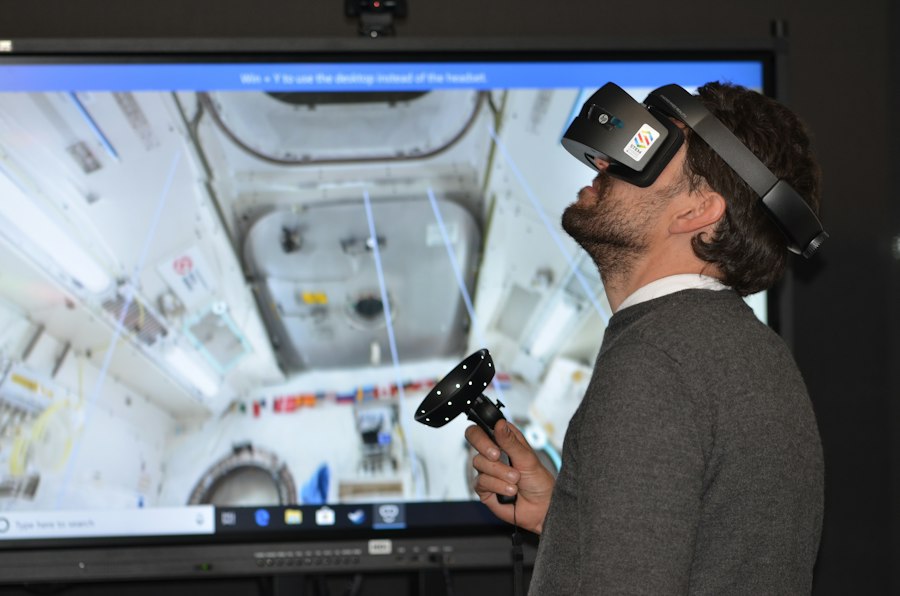
The core of the operator’s interface is a high-performance MR headset (e.g., HoloLens 2, Magic Leap 2, or future devices). This device provides the visual blending of the real and virtual, displaying the digital twin of the remote environment and robot directly in the operator’s field of view, spatially anchored to their physical surroundings.
It needs accurate tracking of the operator’s head, hands, and potentially body to enable natural interaction.
Spatial Computing Platform
Beneath the MR headset lies the spatial computing platform. This software and hardware system is responsible for processing the incoming 3D data from the remote robot, maintaining the local digital twin, rendering the holographic overlay, and interpreting the operator’s gestures and voice commands. It needs powerful processing capabilities to handle real-time 3D rendering and interaction.
Haptic Feedback Devices
For enhanced immersion and tactile information, haptic feedback devices are often integrated.
These could be haptic gloves that simulate the feel of grasping an object or force-feedback controllers that convey the resistance encountered by the robot’s end-effector. This feedback loop provides a crucial sense of presence and helps the operator make more precise manipulations.
Applications and Future Prospects
The convergence of spatial computing and mixed reality is opening up unprecedented possibilities for robotic teleoperation across various industries and scientific domains. The potential impact is vast and continues to expand rapidly.
Hazardous Environments and Remote Operations
This is perhaps the most immediate and impactful application. Sending humans into dangerous or inaccessible places is often costly, risky, or outright impossible.
Nuclear Decommissioning and Maintenance
Cleaning up nuclear waste, inspecting reactors, or decommissioning old facilities are tasks with extremely high radiation exposure risks. Robots can perform these tasks, but precise control is critical. MR allows operators to precisely manipulate robotic arms for delicate disassembly or handling of radioactive materials, with the added benefit of being able to visualize radiation levels or structural integrity data directly overlaid onto the remote scene.
Deep-Sea Exploration and Underwater Maintenance
The extreme pressures, darkness, and limited visibility of the deep sea make human presence challenging. Remotely operated vehicles (ROVs) are already common, but MR can elevate their control. Operators could feel a sense of “being there” in the deep ocean, using spatial anchors to navigate complex underwater structures, perform repairs on subsea pipelines, or collect delicate samples, all while viewing 3D bathymetric maps and sensor data in their workspace.
Space Exploration and Planetary Robotics
Operating rovers and robotic arms on the Moon or Mars involves immense communication delays. Supervisory control with predictive MR displays is essential here. Astronauts or mission controllers on Earth could use MR to plan complex sampling missions, drill operations, or surface traverses, visualizing the terrain in 3D and pre-programming sequences, with the robot executing these tasks autonomously and reporting back with updates visualized in the MR interface.
Advanced Manufacturing and Industrial Automation
Even within controlled factory environments, MR and spatial computing can enhance teleoperation for complex tasks that require human dexterity or problem-solving.
Remote Assistance and Collaborative Robotics
Imagine a technician in a factory encountering an unusual fault on a robotic assembly line. Instead of flying in an expert, the local technician, wearing an MR headset, could share their view with the remote expert. The expert could then provide holographic annotations, draw virtual pointers, or even virtually demonstrate the correct repair procedure, guiding the local technician through complex steps on the actual equipment. This significantly reduces downtime and travel costs.
Flexible Production and Reconfiguration
As manufacturing moves towards more customized and flexible production, robots need to be quickly reprogrammed or retasked. MR allows operators to intuitively “teach” robots new tasks by demonstrating movements or defining new work zones and pick-and-place locations directly in the 3D space, rather than relying on complex programming interfaces. This speeds up robot deployment and reconfiguration.
Disaster Response and Emergency Services
Robots can be invaluable in search and rescue missions after natural disasters or in hazardous incidents where human entry is unsafe.
Search, Rescue, and Inspection
Drones and ground robots equipped with thermal cameras and 3D scanners can map collapsed buildings or hazardous sites. MR interfaces can allow emergency responders to remotely navigate these robots, visualize the internal structure of a damaged building in 3D, identify survivors, or locate hazardous materials, all from a safe distance. The ability to spatially tag points of interest (e.g., “victim found here,” “gas leak here”) within the MR view greatly aids coordination.
In exploring the advancements in robotic teleoperation, one can gain valuable insights from a related article that discusses the best order flow trading software, which highlights the importance of real-time data analysis in complex systems. The integration of spatial computing and mixed reality technologies can significantly enhance the efficiency and precision of robotic operations, much like how effective trading software improves decision-making in financial markets. For a deeper understanding of these technologies and their applications, you can read more about it in this detailed review.
The Road Ahead: Challenges and Innovations
| Metric | Description | Value / Range | Impact on Teleoperation |
|---|---|---|---|
| Latency (ms) | Time delay between operator input and robot response | 10-100 ms | Lower latency improves real-time control and precision |
| Degrees of Freedom (DoF) | Number of independent movements the robot can perform | 6-12 DoF | Higher DoF allows more complex manipulation tasks |
| Spatial Mapping Accuracy (cm) | Precision of environment mapping in mixed reality | 1-5 cm | Improves operator situational awareness and obstacle avoidance |
| Field of View (FoV) in MR Headsets (degrees) | Extent of observable environment in mixed reality display | 90-110° | Wider FoV enhances immersive experience and spatial understanding |
| Operator Cognitive Load (scale 1-10) | Measured mental effort during teleoperation | 3-7 (with MR assistance) | Reduced cognitive load leads to better performance and less fatigue |
| Task Completion Time (minutes) | Time taken to complete complex teleoperation tasks | 15-45 minutes | Mixed reality can reduce time by improving control and feedback |
| Error Rate (%) | Frequency of mistakes or failures during teleoperation | 5-15% | Spatial computing reduces errors by enhancing spatial awareness |
While the promise of spatial computing and mixed reality in robotic teleoperation is immense, there are still significant challenges to overcome, driving ongoing research and development.
Technical Hurdles and System Integration
Bringing together all the necessary components—high-fidelity sensors, robust communication, sophisticated spatial computing engines, and immersive MR hardware—into a seamless and reliable system is no small feat.
Sensor Fusion and Environmental Mapping
Achieving a truly accurate and robust real-time 3D digital twin requires advanced sensor fusion algorithms that combine data from multiple sensor types (LiDAR, cameras, IMUs) to create a comprehensive and consistent map of the environment, even in challenging conditions like varying lighting or featureless terrains. The system also needs to cope with dynamic environments where objects move or change.
Latency and Bandwidth Optimization
Despite the mitigation strategies discussed, further reductions in perceived and actual latency are always desirable. This involves optimizing communication protocols, implementing more efficient data compression techniques, and developing more sophisticated predictive modeling that can accurately anticipate robot behavior over longer time horizons. Edge computing, where some processing happens closer to the robot or the operator, also plays a crucial role.
Human Factors and Usability
Designing intuitive and non-fatiguing MR interfaces is critical. Over-reliance on visual information can lead to cognitive overload, and poor interface design can cause motion sickness or discomfort. Research into optimal control paradigms, feedback modalities (visual, auditory, haptic), and the long-term effects of MR use on operators is ongoing. The goal is to make the interaction as natural and effortless as possible.
Trust and Autonomy Levels
Determining the right balance between human control and robot autonomy is a continuous challenge, especially in complex and critical teleoperation scenarios.
Dynamic Autonomy Switching
Future systems will likely feature more fluid transitions between fully teleoperated control, shared autonomy (where human and robot collaborate on tasks), and full robot autonomy. MR interfaces will be crucial for the operator to understand the robot’s current autonomy level, its intent, and to seamlessly take over or delegate control as needed. Building operator trust in autonomous capabilities is paramount.
Ethical and Safety Considerations
As robots become more autonomous and capable of operating in critical environments, the ethical implications of their actions and the safety of the human-robot interaction become even more pronounced. How do we ensure robots act predictably and safely, especially when humans are “in the loop” but not in direct, continuous control? Clear communication of robot status, potential risks, and fallback procedures through the MR interface will be essential.
The journey of spatial computing and mixed reality in complex robotic teleoperation is just beginning. As these technologies mature and become more integrated, they promise to unlock capabilities that will redefine how we interact with and extend our reach through intelligent machines, making the impossible, possible.
FAQs
What is spatial computing?
Spatial computing refers to the integration of digital information with the physical world, allowing for interaction and manipulation of virtual objects in real-time. It encompasses technologies such as augmented reality (AR), virtual reality (VR), and mixed reality (MR), enabling users to engage with digital content in a spatial context.
How does mixed reality enhance robotic teleoperation?
Mixed reality enhances robotic teleoperation by providing operators with immersive visualizations of the robot’s environment and tasks. This allows for better spatial awareness, improved control, and more intuitive interactions, as operators can see both the physical robot and the virtual elements overlaid in their field of view, facilitating complex operations.
What are the benefits of using spatial computing in complex robotic tasks?
The benefits of using spatial computing in complex robotic tasks include improved precision and efficiency, enhanced situational awareness, and reduced cognitive load on operators. By visualizing data and robot actions in a spatial context, operators can make more informed decisions and execute tasks with greater accuracy.
What challenges are associated with implementing mixed reality in robotic teleoperation?
Challenges associated with implementing mixed reality in robotic teleoperation include technical limitations such as latency and bandwidth issues, the need for robust hardware and software integration, and the requirement for user training to effectively utilize the technology. Additionally, ensuring safety and reliability in dynamic environments can pose significant hurdles.
What industries can benefit from spatial computing and mixed reality in robotic teleoperation?
Industries that can benefit from spatial computing and mixed reality in robotic teleoperation include healthcare (for surgical robots), manufacturing (for assembly and maintenance), logistics (for warehouse automation), and exploration (for remote operations in hazardous environments). These technologies can enhance productivity and safety across various applications.
Enjoying our content? Make us a preferred source on Google:
Add us as a Preferred Source on Google