

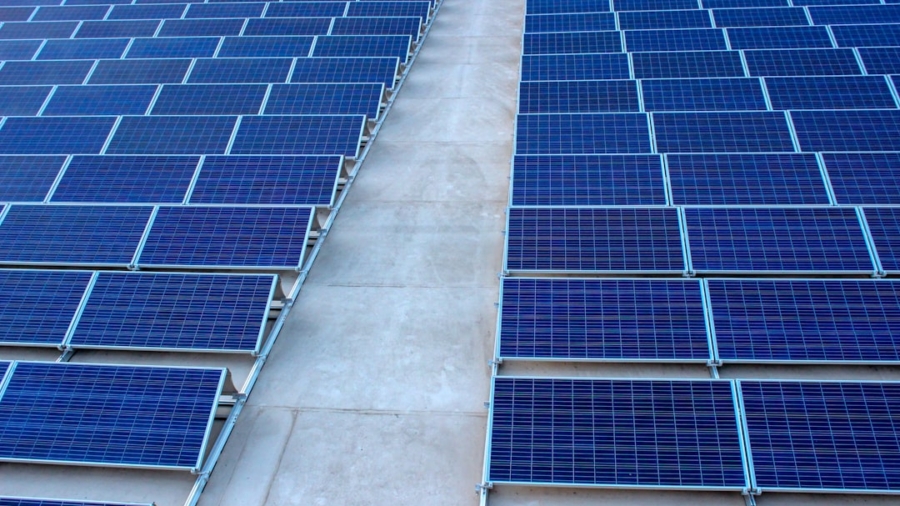
You’ve probably heard about solar panels getting better and better, right? Well, there’s a new player in town that’s really shaking things up, and it’s called the perovskite-silicon tandem solar cell. The big question is: how are these cells managing to push past the 30% efficiency mark, and what does that actually mean for you and me? In a nutshell, it’s all about combining two different types of solar cell materials to capture a wider range of sunlight, leading to significantly more power generation from the same area. Think of it as a power-boosting tag team.
So, what’s so special about putting two solar cell types together? The main idea behind a tandem solar cell is that different materials are good at capturing different parts of the solar spectrum. Sunlight, as we see it, is a mix of different colors, each with a specific wavelength. Traditional silicon solar cells are pretty good at capturing the red and infrared parts of the spectrum. However, they’re not as efficient at grabbing the blue and green light, which carries a lot of energy.
The Limitations of Single-Junction Cells
For decades, the workhorse of the solar industry has been the silicon solar cell, often referred to as a “single-junction” cell. This is because it’s made from a single layer of semiconductor material. While incredibly reliable and cost-effective, silicon cells have a theoretical efficiency limit. This is often called the Shockley-Queisser limit, and for silicon, it hovers around 32%. In practice, commercially available silicon panels are typically in the 20-23% efficiency range. This means a good chunk of the incoming sunlight is simply not converted into electricity.
Perovskites: The New Kid on the Block
Enter perovskites. These are a class of materials with a specific crystal structure. What makes them so exciting for solar is their tunable bandgap and excellent light absorption properties, particularly in the blue and green parts of the spectrum. Unlike silicon, which requires high-temperature, energy-intensive manufacturing processes, perovskite solar cells can often be made using simpler, lower-temperature techniques, sometimes even by “printing” them.
In the quest for more efficient solar energy solutions, the article on The Rise of Perovskite-Silicon Tandem Solar Cells highlights advancements that push efficiency beyond 30%. For those interested in exploring related technological innovations, an intriguing read is available at this link, which discusses the latest developments in smartwatches, showcasing how cutting-edge technology continues to evolve across various fields.
Key Takeaways
- Clear communication is essential for effective teamwork
- Active listening is crucial for understanding team members’ perspectives
- Setting clear goals and expectations helps to keep the team focused
- Regular feedback and open communication can help address any issues early on
- Celebrating achievements and milestones can boost team morale and motivation
How Perovskite-Silicon Tandems Work Their Magic
The “tandem” part comes from layering these two materials. The most common setup for perovskite-silicon tandems involves placing a perovskite solar cell on top of a silicon solar cell. This arrangement is designed to maximize the capture of sunlight.
Capturing More of the Spectrum
The perovskite layer is typically designed to absorb the higher-energy, shorter-wavelength light (the blues and greens). This light is absorbed by the perovskite, and the energy is converted into electricity. The light that the perovskite doesn’t absorb, which tends to be the lower-energy, longer-wavelength light (the reds and infrared), passes through the perovskite layer and is then absorbed by the silicon cell underneath. The silicon cell then converts this portion of the sunlight into electricity.
The “Bandgap” Advantage
The key to this efficiency boost lies in the concept of the “bandgap” of a semiconductor material. The bandgap determines the minimum energy a photon (a particle of light) needs to have to be absorbed and create an electron-hole pair, which is the basis of electricity generation. Silicon has a specific bandgap. Perovskites can be engineered to have different bandgaps. By choosing a perovskite with a higher bandgap and a silicon cell with a lower bandgap, you can effectively “stack” their absorption capabilities.
The perovskite catches the high-energy photons, and the silicon catches the lower-energy ones that pass through.
Reducing Energy Loss
In a single-junction cell, photons with energy much higher than the bandgap are also absorbed, but the excess energy is lost as heat. By using a tandem structure, these high-energy photons are absorbed by the perovskite, and their energy is converted more efficiently. Similarly, photons with energy lower than the bandgap are not absorbed and essentially pass through. By having two materials, you minimize the number of photons that are either too energetic or not energetic enough for efficient conversion by a single material.
Breaking the Efficiency Barrier: Why 30% is Just the Beginning

Achieving efficiencies beyond 30% is a significant milestone. It means more power from less space, which has broad implications for the future of solar energy.
The Theoretical Potential
The theoretical efficiency limit for a two-junction tandem solar cell, like a perovskite-silicon one, is much higher than for a single-junction cell. This limit, known as the Green-Wisnieff limit for a two-junction cell, can theoretically reach over 40%.
While we’re not there yet, the fact that we’re surpassing 30% in practical prototypes shows the immense potential.
Lab Records vs. Real-World Panels
It’s important to distinguish between lab-scale efficiencies and what you’ll find on a rooftop. The record-breaking numbers (like those exceeding 33% for perovskite-silicon tandems) are achieved under controlled laboratory conditions using small, highly optimized cells.
However, these breakthroughs are crucial because they demonstrate what’s possible. The industry then works to scale up these technologies and translate that high efficiency into larger, more robust solar panels that can be manufactured affordably.
What “Beyond 30%” Means for You
For homeowners, this means that if perovskite-silicon tandem technology becomes widely available and affordable, you could generate significantly more electricity from the same roof space. This is particularly important in areas where space is limited or where maximizing energy output is a priority.
For utility-scale solar farms, higher efficiency means needing fewer panels to generate the same amount of power, which can reduce land use and installation costs.
The Hurdles: What’s Holding Them Back?

While the efficiency gains are incredibly promising, perovskite-silicon tandem solar cells are not yet ready for widespread commercial deployment. There are still several significant challenges that need to be overcome.
Stability and Durability
One of the biggest challenges with perovskite materials has historically been their stability. Perovskites can be sensitive to moisture, heat, and UV light, which can degrade their performance over time. While significant progress has been made in improving the stability of perovskite layers, they still generally have a shorter lifespan compared to the decades-long durability expected from silicon solar cells. Encapsulation techniques and material engineering are ongoing areas of research to address this.
Scalability and Manufacturing Costs
Manufacturing perovskite solar cells, especially in the large formats needed for solar panels, is still a complex process. While some manufacturing methods for perovskites are simpler than for silicon, achieving high yields, uniformity, and cost-effectiveness at scale is an ongoing challenge. The integration of perovskite layers with existing silicon manufacturing lines also presents its own set of engineering hurdles.
Lead Content
Many of the most efficient perovskite formulations contain lead. While the amount of lead in a solar panel is generally very small and well-contained, environmental concerns and regulations around lead are a consideration for large-scale deployment. Researchers are actively exploring lead-free perovskite alternatives, though they often come with a trade-off in initial efficiency.
The advancements in solar technology are exemplified by the rise of perovskite-silicon tandem solar cells, which are pushing efficiency levels beyond 30%. This innovative approach not only enhances energy conversion but also opens up new avenues for sustainable energy solutions. For those interested in exploring the broader implications of emerging technologies in various markets, a related article discusses the best niche for affiliate marketing in 2023, highlighting how these advancements can influence consumer behavior and investment opportunities. You can read more about it here.
The Future: When Will We See Them on Our Roofs?
| Metrics | Data |
|---|---|
| Efficiency | Beyond 30% |
| Material | Perovskite-Silicon Tandem |
| Research Topic | Solar Cells |
| Impact | Boosting Efficiency |
The timeline for perovskite-silicon tandem solar cells to become a common sight on rooftops is still a bit fuzzy, but the progress is rapid.
Research and Development Pipeline
There are numerous companies and research institutions around the world actively developing and commercializing this technology. Many are focused on pilot production lines and demonstrating bankable technology. We’re likely to see initial deployments in niche applications or as premium products before they become mainstream.
Gradual Integration
It’s unlikely that perovskite-silicon tandems will completely replace traditional silicon panels overnight. Instead, we’ll probably see a gradual integration. Some manufacturers might offer “hybrid” panels that incorporate a perovskite layer onto existing silicon cells. As the technology matures and costs come down, they could become the standard for new solar installations.
A More Powerful Solar Future
The rise of perovskite-silicon tandem solar cells represents a significant leap forward in solar technology. By intelligently combining the strengths of two different materials, we’re unlocking efficiencies that were once considered theoretical limits. While challenges remain in terms of long-term stability and cost-effective manufacturing, the ongoing advancements suggest that these high-efficiency cells are not a distant dream but a tangible part of our near future, promising to make solar energy even more accessible and powerful.
FAQs
What are perovskite-silicon tandem solar cells?
Perovskite-silicon tandem solar cells are a type of solar cell that combines a layer of perovskite material with a layer of silicon material to capture a broader spectrum of sunlight and increase the overall efficiency of the solar cell.
How do perovskite-silicon tandem solar cells boost efficiency beyond 30%?
Perovskite-silicon tandem solar cells are able to boost efficiency beyond 30% by leveraging the complementary properties of perovskite and silicon materials. The perovskite layer can capture high-energy photons, while the silicon layer captures lower-energy photons, allowing for a more efficient conversion of sunlight into electricity.
What are the advantages of perovskite-silicon tandem solar cells?
Perovskite-silicon tandem solar cells offer several advantages, including higher efficiency, lower manufacturing costs, and the potential for flexible and lightweight solar panels. Additionally, perovskite materials are easier to process and can be deposited using low-cost techniques, making them a promising option for commercial solar cell production.
What are the challenges associated with perovskite-silicon tandem solar cells?
Despite their potential, perovskite-silicon tandem solar cells face challenges such as stability issues, as perovskite materials are sensitive to moisture and oxygen. Additionally, the scalability of perovskite-silicon tandem solar cell production and the long-term reliability of these devices are areas of ongoing research and development.
What is the current state of research and development for perovskite-silicon tandem solar cells?
Research and development for perovskite-silicon tandem solar cells are actively ongoing, with a focus on improving stability, scalability, and long-term reliability. Efforts are also being made to optimize the manufacturing processes and reduce production costs to make perovskite-silicon tandem solar cells a competitive option in the solar energy market.
Enjoying our content? Make us a preferred source on Google:
Add us as a Preferred Source on Google