

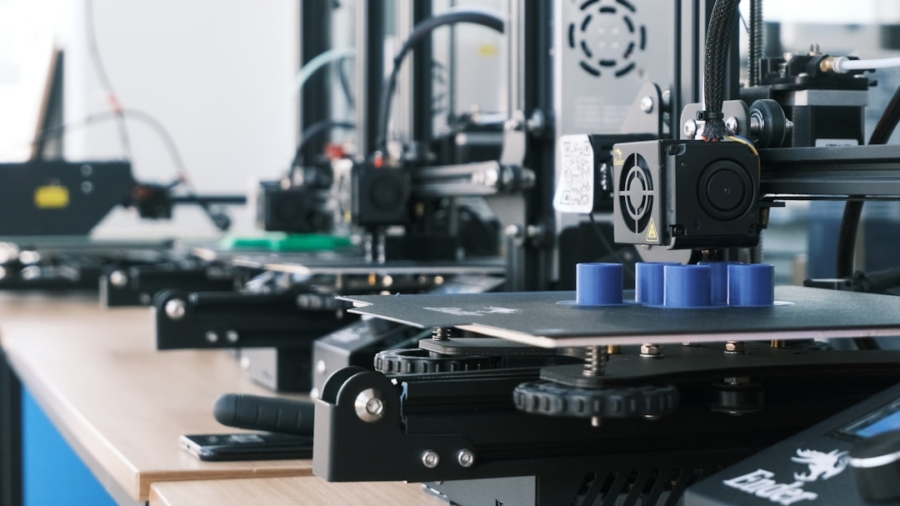
So, how exactly is 3D printing shaking up the world of spacecraft component manufacturing? In a nutshell, it’s making it faster, more customizable, and ultimately more accessible than ever before. We’re talking prototypes in days instead of months, components that are lighter and stronger, and the ability to make one-off parts without huge upfront costs. This isn’t just a niche application; it’s fundamentally changing how we build and launch things into space.
The space industry isn’t like car manufacturing, where you’re churning out millions of identical parts. Spacecraft are often custom-built, unique machines designed for specific missions. This “one-off” or “small batch” nature creates a particular set of challenges for traditional manufacturing.
Traditional Manufacturing’s Limitations
Imagine trying to build a bespoke supercar using methods designed for mass-producing economy sedans. That’s a bit like what the traditional aerospace manufacturing landscape feels like sometimes.
High Tooling Costs
Conventional methods, like casting or CNC machining, often require specialized molds, jigs, and fixtures. These tools are expensive to design and produce, and their cost is typically amortized over a large production run. For a spacecraft component that might only be produced once or a handful of times, these tooling costs become prohibitive. If you’re only making five of something, spending hundreds of thousands on a mold just doesn’t make financial sense.
Long Lead Times
Designing and procuring these specialized tools takes time – weeks, often months. Then, there’s the actual manufacturing process, which can also be lengthy. In an industry where timelines are often critical, waiting months just for tooling can delay an entire mission. This sluggishness can be a serious impediment, especially for agile startups or rapidly evolving scientific missions.
Design Iteration Challenges
Improving a design in traditional manufacturing usually means re-tooling, which brings back those high costs and long lead times. This discourages rapid prototyping and iterative design, making it harder to optimize components or respond to new mission requirements effectively. If a flaw is found or an improvement identified, the cost of implementing that change can be astronomical.
The Rise of Agile Space Exploration
The space industry is undergoing a significant transformation. We’re seeing more private companies, smaller satellites (CubeSats, SmallSats), and ambitious new missions, from asteroid mining to mega-constellations. This new era demands flexibility and speed.
Smaller, Faster Missions
The days of monolithic, decade-long government projects are being complemented by smaller, faster, and often privately funded missions. These missions need their hardware quickly and cost-effectively. They can’t afford the historical baggage of multi-year development cycles.
Think of the explosion of CubeSat constellations; each satellite is relatively inexpensive, but there might be hundreds or thousands of them.
Rapid Prototyping Needs
Engineers need to test ideas and validate designs much earlier in the development cycle. Being able to quickly print a functional prototype, test it, and then refine the design allows for faster innovation and reduces the risk of costly failures later on. This iterative approach is critical for complex systems where unforeseen issues are common.
Customization is Key
Many spacecraft components are unique to their mission. A specific sensor housing, an antenna bracket designed for a particular deployment mechanism, or a propulsion system component tailored for a unique fuel – these aren’t off-the-shelf items. On-demand manufacturing allows for this high degree of customization without the usual penalties.
The impact of 3D printing on on-demand spacecraft component manufacturing is a transformative development in the aerospace industry, enabling rapid prototyping and reducing costs. For further insights into how technology is reshaping various industries, you can explore a related article on Recode, which discusses the latest advancements in technology and their implications for the future. To read more, visit Recode Technology News.
Key Takeaways
- Clear communication is essential for effective teamwork
- Active listening is crucial for understanding team members’ perspectives
- Setting clear goals and expectations helps to keep the team focused
- Regular feedback and open communication can help address any issues early on
- Celebrating achievements and milestones can boost team morale and motivation
How 3D Printing Transforms the Landscape
Additive manufacturing, or 3D printing, directly addresses many of the inherent challenges of traditional spacecraft component production. It flips the script on how we approach design and manufacturing.
Speed and Agility
One of the most immediate benefits is the drastic reduction in lead times. A component that might take weeks or months to machine can often be printed in days.
Rapid Prototyping and Iteration
Engineers can go from a CAD model to a physical part in a matter of hours or days. This rapid turnaround allows for multiple design iterations in a fraction of the time it would take with traditional methods. You can print a part, test it, identify flaws, tweak the design, and print a new version almost immediately. This accelerated design cycle leads to better, more optimized components faster. Imagine discovering a thermal stress issue in a bracket; with 3D printing, you can redesign and print a new version by the next day, rather than waiting weeks for a new machined part.
Shorter Manufacturing Cycles
Once a design is finalized, printing can begin almost immediately. There’s no need to wait for tooling to be fabricated and shipped. This dramatically shortens the overall production timeline, allowing spacecraft to be assembled and launched sooner. This is a huge advantage in competitive markets or time-sensitive scientific missions.
Design Freedom and Optimization
This is where 3D printing truly shines, allowing for geometries simply impossible with traditional manufacturing.
Complex Geometries and Lightweighting
Traditional manufacturing often involves subtracting material (machining) or forming it into a mold. This limits design complexity. 3D printing, by adding material layer by layer, allows for highly intricate internal structures, lattice designs, and organic shapes. This freedom enables engineers to create parts that are significantly lighter yet just as strong, or even stronger, than their traditionally manufactured counterparts. Think of bionic structures inspired by nature, where strength is distributed optimally using minimal material. This lightweighting is crucially important for space, where every gram launched costs thousands of dollars.
Part Consolidation
Instead of assembling a component from multiple smaller pieces – each requiring its own manufacturing, inspection, and assembly – 3D printing can combine several functions into a single, complex part. This reduces part count, simplifies assembly, improves reliability (fewer interfaces to fail), and often leads to further weight savings. For example, an entire manifold with intricate internal fluidic pathways can be printed as one piece, rather than being welded together from many small tubes and fittings.
Functionality at the Micro-scale
Certain 3D printing techniques, particularly those using polymers or ceramics, can produce features at incredibly fine resolutions. This opens up possibilities for integrated sensors, micro-fluidic channels, or even embedded electronics directly within the structural components, leading to “smarter” and more compact designs. Imagine a structural beam that also contains internal pressure sensors, all printed as one unit.
Materials Revolution for Space Applications

3D printing isn’t just about the process; it’s also about the materials that can now be utilized in new ways. The ability to work with advanced polymers and metals is a game-changer.
High-Performance Polymers
While metals often get the spotlight, advanced polymers are carving out a significant niche for 3D printed spacecraft components, especially for less structually demanding applications or for specific thermal/electrical properties.
Lightweight & Insulating Properties
Polymers like PEEK (Polyether ether ketone) or PEKK (Polyetherketoneketone) offer excellent strength-to-weight ratios, making them ideal for brackets, housings, and protective covers where mass is critical. They also provide good electrical insulation and thermal resistance, which can be advantageous in various subsystems.
This is critical for antennas, cable management, and various enclosures.
Radiation Shielding Potential
Certain polymer composites can be engineered with specific fillers (e.g., boron, bismuth) to provide varying degrees of radiation shielding. This is an active area of research, as traditional metallic shielding is often very heavy. 3D printing allows for the precise placement of these shielding materials exactly where they are needed, optimizing efficiency.
FDM & SLA for Prototyping
For initial prototypes and non-critical components, Fused Deposition Modeling (FDM) and Stereolithography (SLA) printers using various plastics (ABS, PC, resins) are invaluable.
They offer a quick and cost-effective way to test form, fit, and function before committing to more expensive metal prints.
Advanced Metal Alloys
Metal 3D printing (often called Additive Manufacturing for metals) is truly revolutionary for structural and high-performance components. Techniques like Selective Laser Melting (SLM) and Electron Beam Melting (EBM) are commonly used.
Titanium Alloys (Ti-6Al-4V)
Titanium is a workhorse in aerospace due to its exceptional strength-to-weight ratio and corrosion resistance. 3D printing allows for complex titanium parts that are lighter and stronger than their traditionally manufactured counterparts.
This includes structural brackets, propulsion system components, and even satellite bus structures. The ability to create complex internal lattices in titanium significantly boosts performance.
Nickel-based Superalloys (Inconel)
For components operating under extreme heat and pressure, such as rocket engine nozzles or combustion chambers, nickel-based superalloys like Inconel are critical. 3D printing enables the creation of intricate cooling channels and optimized geometries for these high-temperature applications, improving efficiency and durability.
GE’s LEAP engine fuel nozzle is a famous example, going from 20 welded parts to 1 3D printed part.
Aluminum Alloys (AlSi10Mg)
While not as strong as titanium or Inconel, specialized aluminum alloys suitable for 3D printing offer a good balance of strength, lightweighting, and thermal conductivity. These are excellent for heat exchangers, optical benches, and structural elements where thermal management is important.
Refractory Metals (Tungsten, Niobium)
These super-high-temperature resistant metals are incredibly difficult to machine conventionally. 3D printing is opening doors to using them for niche applications where extreme heat is present, such as some advanced propulsion systems or re-entry vehicle components.
This is still an emerging area but holds immense promise.
On-Orbit Manufacturing and Repair

Perhaps one of the most exciting long-term prospects for 3D printing in space is the ability to manufacture and repair components in space itself. This could fundamentally change how we plan missions and sustain a long-term human presence beyond Earth.
Reducing Launch Mass
Every pound launched into space costs thousands of dollars. If even a small percentage of components can be manufactured on orbit from raw materials, or by recycling waste materials, it could lead to significant cost savings and allow for more payload dedicated to scientific instruments or crew supplies. This changes the economics of space travel dramatically.
Printing Tools and Spares
Imagine an astronaut needing a specific wrench or a replacement bracket for a scientific experiment. Rather than waiting for the next resupply mission, which could be months away, they could simply print it on demand. This drastically improves operational efficiency and crew safety, reducing reliance on Earth for critical items.
Customized Mission Adaptations
During a long space mission, plans can change. Scientific objectives might evolve, or unforeseen needs could arise. On-orbit 3D printing allows for the construction of specialized tools, fixtures, or even small experimental apparatus tailored to these new requirements without needing to launch something bespoke from Earth.
Repair and Maintenance Beyond Earth
Space is a harsh environment, and components can degrade or fail. The ability to repair or replace parts on orbit is a huge advantage.
Damage Mitigation
Whether it’s micrometeoroid impacts, radiation degradation, or mechanical failure, components in space are exposed to a lot. 3D printing could enable in-situ repair, potentially extending the lifespan of satellites, space stations, and future planetary habitats. Imagine patching a small hole in a habitat wall or repairing a damaged antenna.
Recycling and Resource Utilization
Future long-duration missions and lunar/Martian bases will need to be as self-sufficient as possible. 3D printing plays a key role here, allowing for the recycling of waste plastics or metals into new usable components. This “closed-loop” manufacturing reduces the need for constant resupply from Earth, making deep-space exploration more sustainable. Imagine melting down a broken component to print a new one.
Building Structures In-Situ
Going beyond small components, researchers are exploring the possibility of 3D printing entire large structures in space, such as antennas, solar arrays, or even lunar habitats, using materials sourced from the Moon or asteroids. This distributed manufacturing approach could enable structures much larger than could ever be launched from Earth.
The advancements in 3D printing technology have significantly transformed the landscape of on-demand spacecraft component manufacturing, allowing for rapid prototyping and reduced lead times. A related article that delves into the broader implications of technological innovations in various fields can be found here, where it discusses the best applications for enhancing productivity and connectivity in 2023. This exploration highlights how such tools can complement the efficiency gains seen in industries like aerospace, ultimately driving forward the capabilities of modern manufacturing. For more insights, you can read the article here.
Challenges and the Road Ahead
| Metrics | Data |
|---|---|
| Reduction in Manufacturing Time | Up to 50% |
| Cost Savings | Up to 60% |
| Number of Components Manufactured On-Demand | Over 100 |
| Material Waste Reduction | Up to 90% |
| Customization Flexibility | Highly customizable |
While the benefits are clear, 3D printing for spacecraft components isn’t without its hurdles. It’s a rapidly evolving field, and continuous research and development are essential.
Qualification and Certification
Space-bound components require incredibly rigorous testing and certification. Demonstrating that a 3D printed part will reliably perform for years in the vacuum, radiation, and extreme temperatures of space is a significant undertaking.
Repeatability and Consistency
Ensuring that every 3D printed part, regardless of when or where it’s printed, meets the exact same structural and material property specifications is crucial. Variations in printer parameters, material batches, or post-processing can affect quality. Establishing robust process controls and quality assurance methods is paramount.
Defect Detection and Characterization
Minute internal defects (e.g., porosity, un-melted powder) can significantly compromise the strength and integrity of 3D printed metal parts. Developing advanced non-destructive testing techniques (e.g., X-ray computed tomography) to reliably detect and characterize these defects is an ongoing challenge.
Standards Development
The industry is still working on establishing comprehensive standards for the design, manufacturing, and qualification of 3D printed aerospace components. These standards are necessary for widespread adoption and building confidence in the technology.
Material Limitations and Development
While material options are growing, there are still gaps compared to the vast array of traditionally available aerospace materials.
Anisotropic Properties
Many 3D printing processes result in parts with anisotropic properties, meaning their strength and characteristics vary depending on the direction of printing. Understanding and controlling this anisotropy is essential for critical applications.
Novel Materials for Extreme Environments
Further research is needed to develop new 3D printable materials specifically tailored for the extreme conditions of space, including better radiation resistance, higher operational temperatures, and improved fatigue life.
Powder Cost and Availability
The specialized metal powders used in 3D printing are often very expensive, and their supply chains can be less established than for traditional bulk materials. Reducing these costs and increasing availability are important for broader economic viability.
Design Tooling and Simulation
Designing for additive manufacturing (“DfAM”) requires a different mindset and specialized tools.
Advanced Simulation Software
Engineers need sophisticated simulation tools that can accurately predict the behavior of complex 3D printed geometries under various loads, temperatures, and radiation exposures. These tools also need to account for the unique material properties resulting from the additive process.
Topology Optimization Expertise
Leveraging the design freedom of 3D printing requires expertise in topology optimization – software-driven methods for designing parts that are optimally strong and light for their specific load cases. This is a specialized skill set that’s becoming increasingly important.
Data Management and Security
As designs become more complex and intellectual property more valuable, robust data management and cybersecurity protocols are crucial to protect sensitive design files and ensure the integrity of the manufacturing process.
In conclusion, 3D printing is no longer a futuristic concept for space; it’s a present-day reality rapidly gaining traction. From enabling agile small satellite missions to laying the groundwork for on-orbit factories, its impact is profound. While challenges remain, the clear advantages in speed, design freedom, and material utilization mean that additive manufacturing will play an increasingly central role in how we explore and utilize space in the decades to come.
The future of spacecraft components is being printed, layer by ambitious layer.
FAQs
What is 3D printing?
3D printing, also known as additive manufacturing, is a process of creating three-dimensional objects by layering materials based on a digital model.
How does 3D printing impact spacecraft component manufacturing?
3D printing allows for the rapid and cost-effective production of complex and customized spacecraft components on-demand, reducing lead times and enabling faster innovation in the aerospace industry.
What are the benefits of using 3D printing for spacecraft components?
The benefits of using 3D printing for spacecraft components include reduced weight, increased design flexibility, lower production costs, and the ability to create intricate and lightweight structures that are difficult to achieve using traditional manufacturing methods.
What are the challenges of using 3D printing for spacecraft components?
Challenges of using 3D printing for spacecraft components include material limitations, quality control, certification and regulatory hurdles, and the need for specialized expertise in additive manufacturing processes.
What is the future outlook for 3D printing in spacecraft component manufacturing?
The future outlook for 3D printing in spacecraft component manufacturing is promising, with ongoing advancements in materials, processes, and quality control techniques expected to further expand the capabilities and applications of additive manufacturing in the aerospace industry.
Enjoying our content? Make us a preferred source on Google:
Add us as a Preferred Source on Google