

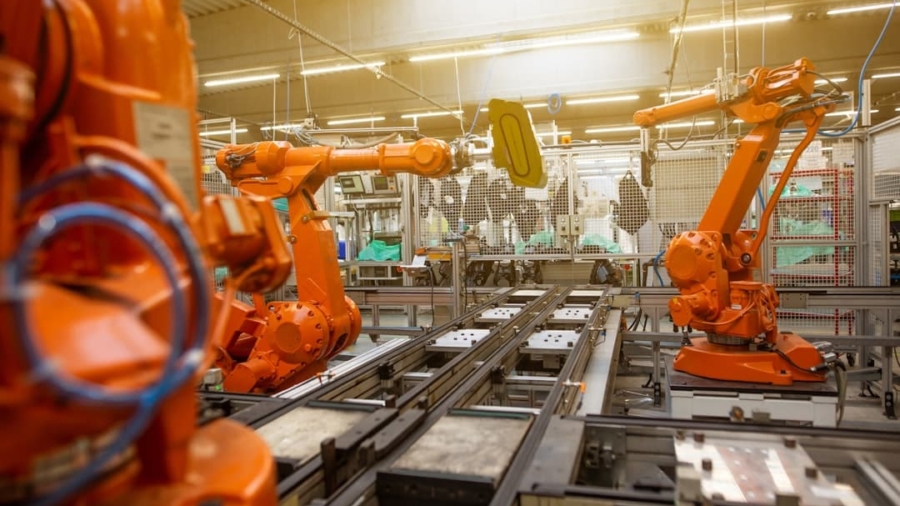
So, you’re wondering about precision robotics in microelectronics assembly. In a nutshell, it’s all about using super-accurate robots to put together the tiny components that make up our modern electronics. Think of it as a highly skilled, incredibly steady hand on a microscopic scale, but one that never gets tired. This technology is what allows us to have the smartphones, powerful computers, and complex medical devices we rely on every day.
It’s easy to take our electronics for granted. Your phone is packed with billions of transistors and intricate circuitry, all smaller than a grain of sand. Making these things isn’t simple; it requires placing components with mind-boggling precision.
The Scale of the Challenge
We’re not talking about assembling car parts here. The components we’re dealing with in microelectronics can range from a few micrometers down to nanometers in size. Imagine trying to pick up a speck of dust and place it exactly where it needs to go, millions of times a day, without error. That’s the kind of accuracy we’re aiming for.
The Demands of Modern Devices
Consumer gadgets are getting smaller, more powerful, and more feature-rich all the time. This trend puts immense pressure on manufacturing processes. To keep up, assembly needs to be fast, repeatable, and incredibly precise. Traditional manual methods just can’t handle the scale and intricacy required.
The Economics of Precision
Even tiny errors can have big consequences in microelectronics. A misaligned component can render an entire chip useless, leading to wasted materials and lost production time. Achieving high yields (meaning a large percentage of products work correctly) is crucial for profitability. Precision robotics directly addresses this by minimizing errors.
In the rapidly evolving field of precision robotics, particularly for microelectronics assembly, staying updated on the latest trends is crucial for industry professionals. A related article that explores current technological advancements and their implications is available at this link: Top Trends on TikTok 2023. This article highlights how social media trends can influence various sectors, including robotics, by showcasing innovative applications and emerging technologies that could reshape the landscape of microelectronics assembly.
Key Takeaways
- Clear communication is essential for effective teamwork
- Active listening is crucial for understanding team members’ perspectives
- Setting clear goals and expectations helps to keep the team focused
- Regular feedback and open communication can help address any issues early on
- Celebrating achievements and milestones can boost team morale and motivation
What Exactly Does “Precision Robotics” Mean Here?
When we talk about precision robotics in this context, we’re not just talking about any robot. These are specialized machines designed for extreme accuracy and delicate handling. They’re the Michelangelo of the microscopic world.
More Than Just a Robot Arm
It’s not just about the robotic arm itself. Precision robotics encompasses a whole system. This includes:
- High-resolution vision systems: These are like the robot’s eyes, allowing it to see and identify the tiny components it needs to manipulate.
- Advanced grippers and end-effectors: These are the “hands” of the robot, designed to pick up and place components without damaging them.
- Sophisticated motion control: This is the “brain” directing the robot’s movements with incredible accuracy and speed.
- Integrated sensors: These provide real-time feedback, allowing the robot to adjust its actions on the fly if needed.
The Role of Repeatability
One of the most significant advantages of robots is their repeatability. Unlike humans, who can get tired or experience slight variations in their movements, a robot can perform the same task identically thousands or millions of times. This consistency is vital for mass production of reliable microelectronic devices.
Understanding Tolerances
In engineering, tolerances are the acceptable limits of variation in measurements. In microelectronics, these tolerances are incredibly tight – often measured in single-digit micrometers. Precision robotics are designed to operate well within these extremely small tolerances.
Key Technologies Enabling Precision Robotics

Several underlying technologies make these incredibly precise robots possible. They’ve evolved significantly over the years, pushing the boundaries of what’s achievable.
Advanced Vision Systems
Seeing is believing, and for microelectronics, “seeing” is everything.
Machine Vision and Image Processing
Modern vision systems use high-resolution cameras and sophisticated algorithms to:
- Locate components: Precisely identify the position and orientation of individual parts on a substrate.
- Inspect for defects: Spot microscopic flaws in components or connections.
- Guidance for placement: Provide real-time feedback to the robot for exact positioning.
3D Vision for Complex Geometries
Some components aren’t flat. 3D vision systems allow robots to understand the shape and depth of objects, enabling them to handle more complex assemblies.
End-Effectors and Gripping Technologies
Picking up something as small and delicate as a semiconductor chip requires specialized tools.
Vacuum Pick-and-Place
One of the most common methods involves using a vacuum nozzle to gently lift and hold components. The size of the nozzle is carefully matched to the component.
Micro-Grippers
For components that might be damaged by vacuum or have unusual shapes, micro-grippers are employed.
These are tiny, delicate mechanical fingers.
Electrostatic Grippers
These use static electricity to hold objects, which can be especially useful for very flat or smooth components.
Motion Control and Actuation
How does a robot move with such precision? It’s all in the control systems.
Servo Motors and Linear Motors
These are the workhorses that provide precise, controlled movement. Servo motors offer angular precision, while linear motors provide direct, backlash-free linear motion.
Force Feedback and Sensing
Some advanced systems incorporate force sensors.
This allows the robot to feel how much pressure it’s applying, preventing damage to delicate parts.
Kinematic Design
The way the robotic arm is designed (its kinematics) plays a role in its reach, dexterity, and precision. Different arms are optimized for different tasks.
Applications of Precision Robotics in Microelectronics

Where exactly are these robots making a difference? The applications are broad and constantly expanding across the microelectronics landscape.
Semiconductor Packaging
This is a primary area where precision robotics shine. After a silicon wafer is processed, it needs to be cut into individual chips and then packaged for protection and connection.
Die Bonding
Attaching the actual silicon die (the tiny square of silicon containing the circuitry) to a substrate or lead frame. This needs to be done with extreme dimensional accuracy.
Wire Bonding
Connecting the tiny pads on the semiconductor die to the external pins of the package using extremely fine wires (often gold or copper). These wires can be as thin as 25 micrometers.
Flip-Chip Assembly
A more advanced packaging technique where the die is flipped upside down and attached to the substrate using solder bumps.
Precision is paramount for aligning these bumps.
Printed Circuit Board (PCB) Assembly
While PCBs can be larger, they often host very small components that require precise placement.
Surface Mount Technology (SMT)
This is the standard method for placing most electronic components onto PCBs today. Robots pick tiny Surface Mount Devices (SMDs) like resistors, capacitors, and integrated circuits (ICs) from feeders and place them precisely onto solder paste applied to the PCB.
Component Re-flow Soldering
After placement, the PCB goes through a reflow oven where the solder paste melts, creating the electrical and mechanical connections. The accuracy of the placement directly impacts the quality of the solder joint.
Micro-Optoelectronics
This field involves the integration of optical and electronic components, often found in things like sensors, communication devices, and displays.
Laser Diode Assembly
Mounting and aligning laser diodes, which require extremely precise orientation for optimal light emission and coupling.
Sensor Integration
Placing tiny image sensors or other sensitive optical components into their housings and aligning them correctly with lenses.
Advanced Manufacturing
Beyond traditional components, precision robots are crucial for newer, more complex manufacturing processes.
Micro-Electro-Mechanical Systems (MEMS) Assembly
MEMS are tiny mechanical devices with both electronic and mechanical functions, fabricated on a silicon chip. Assembling these micro-machines requires nanoscale precision.
Micro-Batteries and Energy Harvesting Devices
The trend towards miniaturization in wearables and IoT devices requires the assembly of tiny power sources with high precision.
Precision robotics has become increasingly vital in the field of microelectronics assembly, enhancing efficiency and accuracy in manufacturing processes. For those interested in exploring the intersection of advanced technology and automation, a related article discusses the latest advancements in AI-driven tools that can significantly improve production workflows. You can read more about these innovations in the context of video generation and automation by visiting this insightful resource.
The Future of Precision Robotics in Microelectronics
| Metrics | Value |
|---|---|
| Accuracy | 98% |
| Speed | 2000 units/hour |
| Repeatability | 0.001 mm |
| Reliability | 99.9% |
The story doesn’t end here. The field of precision robotics for microelectronics is constantly evolving, driven by innovation and the ever-increasing demands of technology.
Increased Automation and AI Integration
We’re seeing a trend towards more intelligent robots that can learn and adapt.
Machine Learning for Process Optimization
AI can analyze vast amounts of production data to identify optimal robotic parameters, leading to higher yields and faster cycle times.
Autonomous Decision-Making
Future robots might be able to identify and correct minor assembly issues without human intervention, further boosting efficiency.
Nanotechnology and Beyond
As components shrink to the nanoscale, the precision requirements will become even more extreme.
Nanoscale Manipulation
Developing robotic systems capable of manipulating individual atoms or molecules for advanced materials and devices.
Atomic Layer Deposition (ALD) Integration
Robots will play an increasing role in the precise application of incredibly thin material layers, crucial for next-generation semiconductors.
Enhanced Collaboration (Cobots)
Collaborative robots, or cobots, are designed to work alongside human operators safely.
Human-Robot Teaming for Complex Tasks
Cobots can handle the repetitive, high-precision tasks, freeing up human workers for more judgment-intensive or dexterous operations.
Skill Transfer and Training
Cobots can potentially be used to demonstrate precise movements, aiding in the training of human technicians.
Miniaturization and Mobility
Robots are also getting smaller and more mobile, opening up new possibilities.
In-situ Assembly and Repair
Developing smaller robots that can perform assembly or even repair tasks directly within larger, complex systems, reducing downtime.
Mobile Robotic Platforms
Robots that can move independently within a factory floor, performing various assembly tasks at different locations.
The journey of precision robotics in microelectronics is a testament to human ingenuity. It’s about pushing the limits of what’s possible, enabling the creation of the advanced technologies that shape our world, one incredibly tiny component at a time.
FAQs
What is precision robotics for micro electronics assembly?
Precision robotics for micro electronics assembly refers to the use of advanced robotic systems to handle and assemble tiny electronic components with high accuracy and precision. These robotics systems are designed to work in small spaces and handle delicate materials with extreme care.
What are the benefits of using precision robotics for micro electronics assembly?
Using precision robotics for micro electronics assembly offers several benefits, including increased accuracy and repeatability, improved production efficiency, reduced human error, and the ability to work in small and confined spaces. These robotics systems also enable the assembly of complex and intricate electronic components with high precision.
What types of tasks can precision robotics perform in micro electronics assembly?
Precision robotics can perform a wide range of tasks in micro electronics assembly, including pick-and-place operations for small components, soldering, dispensing adhesives or coatings, inspection and quality control, and handling delicate materials with high precision. These robotics systems can also be programmed to perform complex assembly tasks with minimal human intervention.
What are some key considerations when implementing precision robotics for micro electronics assembly?
When implementing precision robotics for micro electronics assembly, key considerations include the selection of the right robotic system for the specific assembly tasks, integration with existing manufacturing processes, programming and training of the robotic system, and ensuring the safety of the operators and the delicate electronic components.
What are some examples of industries that benefit from precision robotics for micro electronics assembly?
Industries that benefit from precision robotics for micro electronics assembly include consumer electronics, medical devices, automotive electronics, aerospace and defense, and telecommunications. These industries rely on precision robotics to assemble small and intricate electronic components with high accuracy and efficiency.
Enjoying our content? Make us a preferred source on Google:
Add us as a Preferred Source on Google