

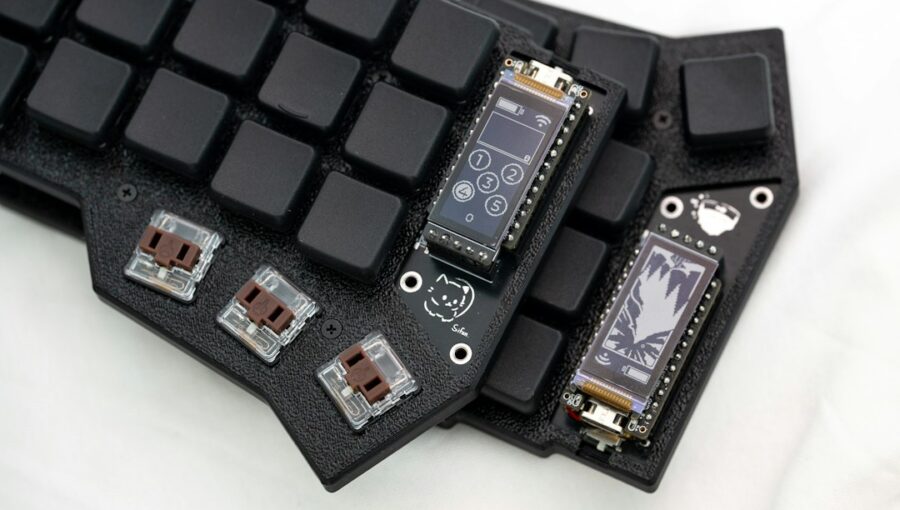
You know that feeling when you’re doing something repetitive on your computer, clicking the same buttons, typing the same phrases? It’s a drag, right? What if you could condense those multi-step actions into a single press of a button? That’s the core idea behind custom macro keypads and keyboard remapping. They’re about making your computer work for you, streamlining tasks, and ultimately, giving you back precious time and mental energy. We’re talking about tangible productivity boosts here, not just vague improvements.
What’s the Big Deal with Macros and Remapping?
At its heart, this isn’t about fancy tech; it’s about efficiency. Think of a macro as a pre-recorded sequence of actions – key presses, mouse clicks, delays – that you can trigger with a single button. Remapping, on the other hand, is about changing what a specific key does. You might turn your Caps Lock key into a Control key, or assign a less-used F-key to open your favorite application. These two concepts, often used together, are incredibly powerful tools for anyone who spends significant time at a computer.
The Problem They Solve
The standard keyboard layout, while functional, isn’t optimized for everyone’s workflow. It’s a general-purpose tool. Many common tasks involve a series of steps: open an application, navigate to a specific folder, type a common phrase, or execute a complex command. These little delays and repetitions add up over hours, days, and weeks. Not only do they consume time, but they also break your flow, forcing you to switch contexts and diverting your mental energy from the actual work. Macros and remapping directly address this by automating those repetitive actions and personalizing your input device to match your unique needs.
Who Benefits Most?
Pretty much anyone who uses a computer regularly can find value here, but some professions or hobbies see particularly significant gains. Programmers can automate code snippets or compilation commands. Video editors can trigger complex effects or switch tools instantly. Designers can streamline their creative suite interactions. Writers can insert boilerplate text or formatting with a single tap. Even everyday users can benefit from quick access to frequently used applications, web pages, or system functions. If you find yourself repeatedly doing the same thing, there’s a good chance a macro or remapping can help.
In the quest for enhanced productivity, the article “Keyboard Mastery: Transforming Productivity with Custom Macro Keypads and Remapping” highlights the significance of tailored keyboard setups. For those looking to optimize their remote work experience, it’s also beneficial to consider the right laptop. A related article that explores this topic is available at Discover the Best Laptop for Remote Work Today, which provides insights into selecting the ideal device to complement your custom keyboard configurations and boost your overall efficiency.
Key Takeaways
- The training data includes information and events up to October 2023.
- Insights and knowledge are based on a wide range of sources available until the cutoff date.
- No updates or developments occurring after October 2023 are included in the training.
- Users should verify current information from reliable sources for the latest updates.
- The model’s responses reflect the context and knowledge available up to the specified date.
Diving into Custom Macro Keypads

Custom macro keypads are essentially mini-keyboards, often with a handful of keys (anywhere from 2 to 30 or more), that are specifically designed for assigning macros. They’re separate from your main keyboard, which gives them a few distinct advantages.
Why a Dedicated Keypad?
One of the biggest reasons to opt for a dedicated macro keypad is to avoid cluttering your main keyboard with too many remapped keys, or accidentally triggering macros during regular typing. A separate keypad keeps your specialized functions in their own dedicated space. This can reduce cognitive load – you know exactly where your macros are without having to remember which obscure key on your main keyboard you remapped. Plus, many keypads offer customizable RGB lighting, allowing you to color-code groups of macros for even easier visual identification. Some even have rotary encoders (knobs) that can be programmed for actions like volume control, zooming, or scrubbing through timelines.
Hardware Options: From Simple to Sophisticated
The market for macro keypads has exploded, offering a range of options to fit different budgets and needs.
Off-the-Shelf Macro Keypads
These are typically plug-and-play devices from brands like Elgato (Stream Deck series), Razer (Tartarus), or even smaller niche manufacturers. They often come with user-friendly software for setting up macros, sometimes even with pre-built integrations for popular applications like OBS or Photoshop. The Elgato Stream Deck, for example, is famous for its customizable LCD keys that can display icons, providing excellent visual cues for each macro. These are great for beginners as they require minimal technical knowledge.
DIY/Custom Keypads
For those who enjoy a bit of tinkering, building your own macro keypad opens up a world of customization. You can choose your switches (Cherry MX, Gateron, etc.
), keycaps, and even the form factor.
Platforms like QMK (Quantum Mechanical Keyboard) firmware are often used for programming these DIY boards, offering unparalleled flexibility. While this path requires more effort and some technical understanding, it results in a keypad that’s perfectly tailored to your exact specifications. You can literally design the layout and functionality from the ground up.
Software for Macro Keypads
Even off-the-shelf keypads usually come with their own proprietary software for configuration. This software typically provides a graphical interface where you can assign actions to each key. For more advanced or DIY setups, open-source firmware like QMK is the gold standard. QMK allows for incredibly complex macros, layers (think Shift or Ctrl for your keypad, giving you more functions than physical keys), and even advanced features like tap-dance (different actions based on how many times you tap a key). Learning QMK has a bit of a learning curve, but the power it unlocks is immense.
The Art of Keyboard Remapping

Remapping your main keyboard isn’t about adding new keys; it’s about changing the behavior of existing ones. This can be as simple as swapping two keys or as complex as assigning multi-key sequences to a single press.
Why Remap Your Main Keyboard?
Sometimes you don’t need a whole separate keypad. Maybe you just want to make a few tweaks to your primary input device.
Remapping can fix ergonomic issues (like moving frequently used keys closer to your natural hand position), replace broken keys, or turn underutilized keys (like Caps Lock or Scroll Lock) into powerful modifiers or macro triggers. It’s about optimizing the tools you already have.
Common Remapping Scenarios
- Caps Lock as Control/Escape: A classic for programmers and Vim users. Moving Control to Caps Lock is much more ergonomic than stretching to the bottom left corner, and combining it with Escape is a common hack for Vim users.
- Fn Key Repositioning: Some laptops have an Fn key in an awkward spot.
Remapping it can make it more accessible.
- Application Launchers: Assigning F-keys or less used keys to instantly launch specific applications.
- Media Controls: If your keyboard lacks dedicated media keys, you can remap existing ones to control volume, playback, etc.
- Symbol Access: For specialized characters or symbols you use often, you can map them to an easy-to-reach key combination.
Software Tools for Remapping
There are several excellent software options available, depending on your operating system and desired level of control.
Karabiner-Elements (macOS)
This is the go-to tool for macOS users. Karabiner-Elements is incredibly powerful and flexible, allowing you to remap individual keys, create complex “hyper” keys (e.g., Caps Lock + H = Home), and even define different mappings for different applications. It can take a bit of learning, but its capabilities are vast.
SharpKeys / PowerToys Keyboard Manager (Windows)
For Windows users, SharpKeys is a straightforward utility for basic key remapping.
It works by editing the Windows registry, so the changes persist across reboots. For a more feature-rich experience, Microsoft’s PowerToys includes a Keyboard Manager that allows for both key remapping and simple shortcut remapping, with a more user-friendly interface than diving into the registry.
AutoHotkey (Windows)
AutoHotkey is a scripting language specifically designed for automation on Windows. While it can remap keys, its true power lies in creating complex macros, hotstrings (automatically expanding text snippets), and even custom user interfaces.
It has a steeper learning curve than SharpKeys or PowerToys but offers unparalleled customization.
xmodmap / Wayland Compositors (Linux)
Linux users often rely on xmodmap for X11-based environments to remap keys. For newer Wayland compositors, the methods can vary, often involving configuration files for the specific compositor (e.g., Sway, Gnome). The approach here is generally more command-line focused and requires a deeper understanding of the system.
Crafting Effective Macros and Remaps
The real magic happens when you thoughtfully design your macros and remappings. It’s not just about automating something; it’s about automating the right things in the right way.
Identifying Repetitive Tasks
Start by observing your own workflow. What actions do you perform multiple times a day, or even multiple times an hour?
- Do you always type the same email signature?
- Do you frequently open a specific folder structure?
- Are there complex keyboard shortcuts in your design software that you constantly struggle to remember or execute?
- Do you paste text without formatting, then have to manually remove the formatting every time?
- Are you constantly switching between applications or virtual desktops?
Make a list. Don’t underestimate the small, seemingly insignificant tasks; they are often the biggest time sinks when accumulated.
Designing Your Macros: Beyond Simple Key Presses
A basic macro might just be a sequence of key presses. But you can get much more sophisticated.
Text Expansion (Hotstrings)
This is one of the easiest and most impactful types of macros. Type a short trigger (e.g., ;;sig or xemail) and have it instantly expand into a full email signature, a boilerplate response, or a common code snippet. Tools like AutoHotkey excel at this, but many macro keypads also support it.
Application-Specific Macros
Many modern macro software (especially for gaming keyboards or dedicated stream decks) allow for application-specific profiles. This means a macro on key ‘X’ might do one thing in Photoshop and something completely different in your code editor. This prevents conflicts and allows for highly contextual automation.
Delays and Mouse Clicks
Sometimes a task requires a brief pause, or a specific mouse click at a certain screen coordinate. Macro tools often allow you to insert delays (in milliseconds) to ensure applications have time to respond, and to record or specify mouse clicks. Be cautious with precise mouse clicks, as screen resolution changes or UI updates can break them.
Relative mouse movements or hotkeys are generally more robust.
Conditional Logic (Advanced)
Some advanced macro tools (like AutoHotkey) even allow for basic conditional logic. For example, “if application A is active, then do X, otherwise do Y.” This pushes into scripting territory but opens up a lot of possibilities for truly intelligent automation.
Organizing Your Keypad Layout
Once you have a list of tasks, think about how to logically group them on your keypad.
- Frequency of Use: Put your most used macros in the easiest-to-reach spots.
- Related Functions: Group macros that perform similar actions or are used in the same context. For example, all your video editing transport controls (play, pause, fast forward) might be together.
- Color-Coding: If your keypad has RGB lighting, use different colors to signify different categories of macros (e.g., red for system commands, blue for communication, green for application-specific tools).
- Layers: Think of layers like the Shift key. A single physical key can have multiple functions. You might have a “default” layer, and then press a “layer switch” key to access a second set of macros for a different application or set of tasks. This dramatically increases the number of available functions without adding more physical keys.
In exploring the benefits of enhancing productivity through technology, a related article discusses the importance of ergonomic design in workspaces, which complements the use of custom macro keypads and remapping techniques. By integrating these tools, users can significantly streamline their workflows and reduce strain during long hours of work. For more insights on optimizing your workspace for better efficiency, you can check out this informative piece on ergonomic solutions here.
Integrating into Your Workflow
| Metric | Description | Impact on Productivity | Example Value |
|---|---|---|---|
| Macro Keypad Usage Frequency | Number of times custom macro keys are used per hour | Higher usage correlates with faster task completion | 45 times/hour |
| Task Completion Time Reduction | Percentage decrease in time to complete repetitive tasks | Directly improves overall workflow efficiency | 30% |
| Error Rate | Number of input errors before and after remapping | Lower error rate reduces rework and frustration | Reduced from 8% to 2% |
| Custom Key Bindings Created | Number of personalized key remaps configured | More bindings enable tailored workflows | 15 bindings |
| Learning Curve Duration | Time taken to become proficient with custom setup | Shorter duration means quicker productivity gains | 2 days |
| User Satisfaction Score | Average rating of comfort and efficiency (scale 1-10) | Higher scores indicate better user experience | 8.7 |
Getting a macro keypad or remapping your keyboard is just the first step. The real challenge is integrating these tools smoothly into your daily workflow until they become second nature.
The Learning Curve and Muscle Memory
Initially, you’ll probably forget your macros exist or struggle to remember which key does what. This is normal. The key is persistence.
- Start Small: Don’t try to automate everything at once. Pick 2-3 highly repetitive tasks and create macros for those first.
- Visual Cues: For macro keypads with LCD screens (like the Stream Deck), use clear icons. For others, use distinct keycaps or color-coding.
- Practice Deliberately: Force yourself to use your macros even when it feels slower at first. The muscle memory will build faster than you think.
- Iterate and Refine: Your first set of macros won’t be perfect. As you use them, you’ll realize better ways to structure them or new tasks that could be automated. Don’t be afraid to tweak and improve.
Backup Your Configurations
This is crucial! After you’ve spent time crafting your perfect setup, make sure to back up your macro profiles and remapping configurations. Whether it’s an export file from your software or a copy of your AutoHotkey script, losing your setup can be a real pain. Cloud storage is your friend here.
Beyond Personal Productivity: Collaboration and Sharing
While typically a personal endeavor, custom keyboard setups can sometimes benefit teams. If multiple people on a team perform identical repetitive tasks, sharing macro scripts or keypad layouts can standardize processes and boost collective efficiency. This requires a bit more coordination and ensuring everyone has the same hardware or software setup, but it can be a powerful tool for consistency.
Ultimately, keyboard mastery through custom macro keypads and remapping isn’t about becoming a tech wizard; it’s about taking control of your digital environment. It’s about recognizing inefficiencies and proactively building solutions that free up your time and focus for the work that truly matters. Give it a try – you might be surprised how much time you get back.
FAQs
What is a custom macro keypad?
A custom macro keypad is a specialized keyboard device that allows users to program and assign custom macros to specific keys. These macros can automate repetitive tasks, improve workflow efficiency, and enhance productivity.
How can remapping keys on a keyboard improve productivity?
Remapping keys on a keyboard can improve productivity by allowing users to customize the layout of their keyboard to better suit their needs and preferences. This customization can reduce strain on the hands and fingers, streamline common tasks, and increase typing speed.
What are the benefits of using custom macro keypads for gaming?
Custom macro keypads can provide gamers with a competitive edge by allowing them to assign complex in-game actions to a single key press. This can help improve reaction times, execute advanced maneuvers more efficiently, and enhance overall gaming performance.
Can custom macro keypads be used for programming and coding?
Yes, custom macro keypads can be highly beneficial for programming and coding tasks. Programmers can assign frequently used code snippets, shortcuts, or commands to macro keys, saving time and reducing the risk of errors during coding sessions.
Are custom macro keypads compatible with all computers and operating systems?
Most custom macro keypads are designed to be compatible with a wide range of computers and operating systems. However, it is important to check the product specifications and requirements to ensure compatibility with your specific setup before making a purchase.
Enjoying our content? Make us a preferred source on Google:
Add us as a Preferred Source on Google