

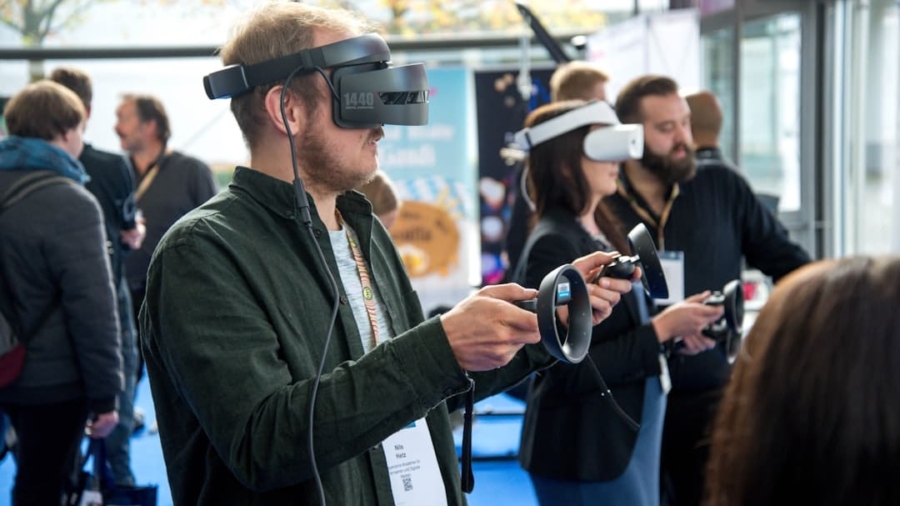
Immersive training simulators, particularly those leveraging Virtual Reality (VR), are fundamentally changing how companies bring new employees up to speed. Forget dry PowerPoint presentations and awkward HR intros; VR is offering a hands-on, engaging, and demonstrably effective way to get new hires comfortable and competent in their roles faster. It’s not just about making training “fun,” it’s about making it stick and preparing people for real-world challenges in a safe, controlled environment.
Moving Beyond Traditional Methods
For decades, corporate onboarding has largely relied on a mix of lectures, manuals, and shadowing. While these methods have their place, they often fall short in replicating the actual demands of a job. Information can be easily forgotten, concepts might remain abstract, and the sheer volume of material can be overwhelming. This is where VR training steps in, offering a paradigm shift.
Learning by Doing, Not Just Listening
The core advantage of VR for onboarding is its ability to facilitate experiential learning. Instead of just hearing about a procedure, new hires can physically perform it. This hands-on approach taps into different learning styles and significantly improves knowledge retention. Imagine a new salesperson practicing a client pitch or a technician learning to operate complex machinery – VR makes these scenarios repeatable and provides immediate feedback.
Safety First, Always
Some job functions carry inherent risks. Training for these roles traditionally involves significant safety protocols, expensive equipment, and potential for accidents. VR eliminates these risks entirely. New employees can repeatedly practice in hazardous environments, operate dangerous machinery, or respond to emergency situations without any real-world consequences. This builds confidence and competence without putting individuals or valuable assets in harm’s way.
Cost-Effectiveness in the Long Run
While the initial investment in VR hardware and custom content might seem substantial, the long-term cost savings can be significant. Reduced travel expenses for trainers, less wear and tear on physical equipment, fewer errors due to insufficient training, and faster time-to-productivity for new hires all contribute to a strong return on investment. Furthermore, the ability to scale training to large numbers of employees simultaneously is a major advantage.
Immersive training simulators are revolutionizing corporate onboarding by providing engaging and interactive experiences that enhance learning retention. A related article that explores the technological advancements in training tools is available at Best Tablet with SIM Card Slot, which discusses how mobile devices can support immersive training solutions, making it easier for companies to implement effective onboarding processes.
Key Takeaways
- Clear communication is essential for effective teamwork
- Active listening is crucial for understanding team members’ perspectives
- Conflict resolution skills are necessary for managing disagreements
- Trust and respect are the foundation of a successful team
- Collaboration and cooperation are key for achieving common goals
How VR Trainers Actually Work
Immersive training simulators are revolutionizing corporate onboarding by providing engaging and interactive experiences that enhance learning and retention. A related article discusses the best software for online arbitrage, which highlights how technology can streamline various business processes and improve efficiency. By integrating tools that facilitate training and development, companies can better prepare their employees for success in a competitive environment. For more insights, you can read the article on best software for online arbitrage.
Creating Realistic Environments
VR training simulators don’t just throw you into a digital void. They meticulously recreate the physical spaces and scenarios relevant to a particular job. This can range from the factory floor of a manufacturing plant to the busy aisles of a retail store, or even a complex surgical suite. The visual fidelity and spatial accuracy are key in making these virtual environments feel convincing.
From Blueprints to Bytes: Content Creation
Developing custom VR training modules requires thoughtful design and technical expertise.
It involves understanding the specific learning objectives, mapping out the user’s journey, and building interactive elements that respond to their actions.
This can involve 3D modeling, animation, and sophisticated programming to ensure the simulation behaves realistically.
The Role of Haptic Feedback
Simply seeing and hearing isn’t always enough. Many advanced VR simulators incorporate haptic feedback – the sense of touch. This allows trainees to feel the resistance of a tool, the vibration of an engine, or the texture of a material. This added layer of sensory input dramatically enhances the realism and effectiveness of the training, making the virtual experience feel much closer to the real thing.
Interactive Scenarios and Tasks
The real power of VR lies in its interactivity. Trainees aren’t passive observers; they are active participants. They can pick up objects, operate controls, interact with virtual colleagues, and make decisions that have consequences within the simulation. These interactions are designed to mirror the actual tasks and challenges employees will face in their day-to-day roles.
Branching Narratives and Decision Points
Effective VR training often incorporates branching narratives. This means that the user’s decisions influence the progression of the scenario. If a trainee makes a mistake, the simulation can adapt, providing immediate corrective feedback or leading to a different outcome that highlights the consequences of their actions. This adaptive learning makes the training more dynamic and personalized.
Performance Tracking and Analytics
One of the most significant benefits of VR training is the wealth of data it can collect. The system can track every action a trainee takes, every decision they make, and their overall performance against predefined metrics. This provides invaluable insights into areas where an individual excels and areas where they need further development.
Debriefing and Feedback Mechanisms
After a VR training session, a crucial step is the debriefing. This is where the real learning solidifies. The system can provide detailed reports on the trainee’s performance, highlighting specific errors and successful actions.
This feedback is often delivered by a virtual instructor or can be reviewed by a human trainer, allowing for personalized guidance and reinforcement.
Reinforcing the “Why” and “How”
The debriefing isn’t just about pointing out mistakes. It’s about connecting the actions taken within the simulation to the underlying principles and best practices. For example, if a trainee mishandled a customer complaint, the debrief could explain the psychological impact of certain phrases or demonstrate alternative approaches.
Specific Applications of VR in Onboarding

Technical Skills and Equipment Operation
For industries that rely on complex machinery or intricate technical processes, VR is a game-changer. New hires can learn to operate and maintain equipment without the risk of damage or injury. This is particularly valuable in manufacturing, aviation, healthcare, and energy sectors.
####
FAQs

What are immersive training simulators?
Immersive training simulators are virtual reality (VR) environments that replicate real-life scenarios to provide hands-on training experiences for employees. These simulators use VR technology to create a realistic and interactive learning environment.
How is VR reshaping corporate onboarding?
VR is reshaping corporate onboarding by providing a more engaging and effective training experience for new employees. It allows them to practice real-life tasks in a safe and controlled virtual environment, leading to better retention and application of knowledge.
What are the benefits of using immersive training simulators for corporate onboarding?
Some benefits of using immersive training simulators for corporate onboarding include increased engagement, improved knowledge retention, reduced training costs, and the ability to practice complex or dangerous tasks in a safe environment.
What industries can benefit from using immersive training simulators?
Various industries can benefit from using immersive training simulators, including healthcare, manufacturing, construction, aviation, and customer service. These simulators can be tailored to specific industry needs and provide realistic training experiences for employees.
What are some examples of immersive training simulators being used in corporate onboarding?
Examples of immersive training simulators being used in corporate onboarding include virtual reality simulations for medical procedures, equipment operation training for manufacturing and construction, and customer service scenarios for retail and hospitality industries.
Enjoying our content? Make us a preferred source on Google:
Add us as a Preferred Source on Google