

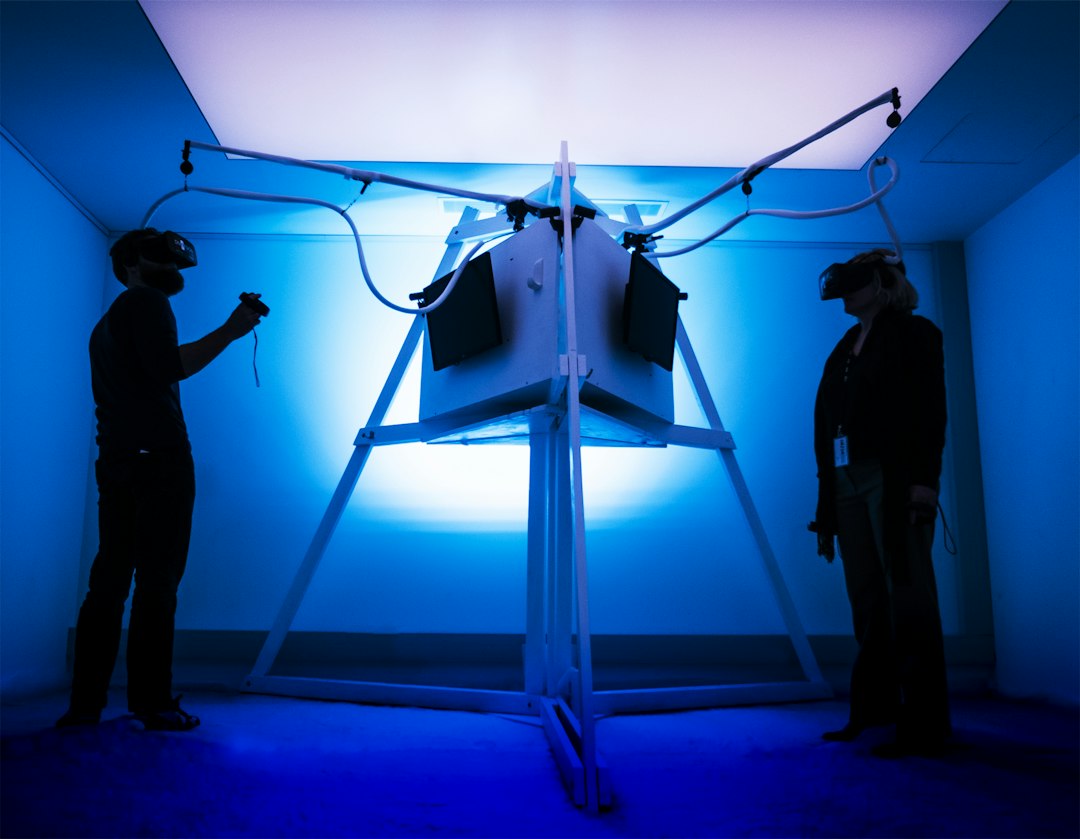
Sure, here’s an article about ‘Acoustic Ray Tracing and Spatial Audio: Enhancing Immersion in Virtual Simulations’:
Acoustic ray tracing and spatial audio are crucial for creating truly immersive virtual simulations because they accurately model how sound behaves in a digital environment, giving users a realistic sense of direction, distance, and environmental presence.
Without it, virtual worlds would feel flat and unconvincing, as sound is a powerful, often subconscious, driver of our perception of reality.
Let’s dig into how these technologies work together to make virtual experiences much more believable.
The Foundation: Understanding Spatial Audio
Spatial audio, in simple terms, is about making sound seem like it’s coming from a specific point in a 3D space, rather than just from your left and right speakers. Think of it like a 3D soundscape. Instead of just hearing a sound, you can perceive its origin and how it interacts with the virtual environment. This goes far beyond basic stereo, which merely pans sound between two channels. Real-world listening involves complex interactions between sound waves and our ears and head, which spatial audio aims to replicate digitally.
How Our Ears Localize Sound
Our brains are remarkably good at figuring out where a sound is coming from. This isn’t just a party trick; it’s a vital survival mechanism. We use a few key cues:
- Interaural Time Difference (ITD): This is the tiny difference in time it takes for a sound to reach one ear compared to the other. If a sound is coming from your left, it hits your left ear a fraction of a second before your right. Our brains are incredibly sensitive to these microseconds.
- Interaural Level Difference (ILD): The sound reaching the ear closer to the source will be slightly louder than the sound reaching the farther ear. This is due to the “head shadow” effect, where your head partially blocks high-frequency sounds from reaching the far ear.
- Head-Related Transfer Functions (HRTFs): This is where things get really intricate. Our outer ear (pinna), head, and torso all subtly modify incoming sound waves based on their angle of arrival. These modifications are unique to each individual and provide crucial directional cues, especially for sounds directly in front, behind, or above us. HRTFs are complex filters that describe these changes across various frequencies and angles.
Different Approaches to Spatial Audio
Achieving spatial audio in a virtual environment can be done in a few ways, each with its own advantages and complexity:
- Binaural Audio: This is the most common and often most effective method for headphones. It directly applies HRTFs to audio signals, essentially simulating how sound would reach a listener’s eardrums if they were present in the virtual space. It’s incredibly convincing because it leverages the same cues our brains use in real life. However, HRTFs are highly individual, and using a generic HRTF can sometimes feel slightly “off” for some users.
- Object-Based Audio: Instead of mixing all sounds into a few channels, object-based audio treats each sound source (e.g., a car, a bird, a person speaking) as an individual “object” with its own position and properties within the 3D scene. The audio renderer then processes these objects and their metadata (position, velocity, volume, etc.) in real-time to create a spatialized output tailored to the listener’s specific playback system (headphones, speaker array). This provides much more flexibility and scalability.
- Ambisonics: This is a method for capturing and reproducing full 3D sound fields. It encodes the directional components of a sound scene into a special multi-channel format that can then be decoded for various speaker setups or binaural playback. It’s often used for recording real-world 3D audio environments or for creating synthetic spatial audio, and it offers good flexibility but can be computationally intensive, especially at higher orders (which provide more accurate directional information).
Acoustic Ray Tracing and Spatial Audio play a crucial role in enhancing immersion in virtual simulations, allowing users to experience sound in a more realistic and engaging manner. For those interested in the intersection of technology and career opportunities, a related article discusses the best-paying jobs in tech for 2023, highlighting the growing demand for expertise in fields like audio engineering and immersive technology. You can read more about these lucrative career paths in the article found here: Discover the Best Paying Jobs in Tech 2023.
Key Takeaways
- The training data includes information and events up to October 2023.
- Insights and knowledge are based on a wide range of sources available until the cutoff date.
- No updates or developments occurring after October 2023 are included in the training.
- Users should verify current information from reliable sources for the latest updates.
- The model’s responses reflect the context and knowledge available up to the specified date.
Acoustic Ray Tracing: Simulating Sound’s Journey
While spatial audio focuses on how we perceive sound, acoustic ray tracing deals with what sound reaches our ears and how it gets there. It’s a method inspired by visual ray tracing, where individual “rays” of sound are simulated as they travel through a virtual environment, interacting with surfaces, reflecting, absorbing, and diffusing. This process is crucial for creating realistic echoes, reverberation, and occlusions – the environmental nuances that truly ground a sound in its virtual space.
The Physics Behind Sound Propagation
Sound isn’t just a straight line; it’s a wave that behaves according to physical laws. Understanding these is key to simulating it accurately:
- Reflection: When a sound wave hits a hard, flat surface (like a concrete wall), a portion of it bounces off, much like a ball. The angle of incidence equals the angle of reflection. This is what causes echoes.
- Absorption: Not all sound reflects. Softer, porous materials (like curtains, carpet, or acoustic panels) absorb some of the sound energy, converting it into heat. This reduces the reflected sound and makes a room sound “dead.”
- Diffusion: Irregular or textured surfaces (like a stone wall or a bookshelf) scatter sound waves in many directions rather than reflecting them predictably. This creates a more diffuse, spread-out sound field rather than distinct echoes.
- Diffraction: Sound waves can bend around obstacles or spread through openings (like a doorway). This is why you can still hear someone talking from the next room even if there isn’t a direct line of sight. Simulating diffraction is complex but vital for true realism.
- Transmission: Sound can pass through materials, though its intensity is usually attenuated (reduced). The amount of transmission depends on the material’s density and thickness.
How Acoustic Ray Tracing Works
The core idea of acoustic ray tracing is to model these interactions. Here’s a simplified breakdown:
- Sound Emitter: A sound source is defined in the virtual scene, emitting rays of sound in various directions.
- Ray Propagation: Each ray travels in a straight line until it encounters a surface in the virtual environment.
- Surface Interaction: When a ray hits a surface, the system calculates how the sound interacts based on the surface’s material properties (absorption, reflection, diffusion coefficients).
- Reflection: New reflected rays are generated, bouncing off the surface.
- Absorption: The energy of the reflected ray is reduced.
- Diffusion: If the surface is diffuse, multiple new rays might be generated in different directions.
- Transmission: The system might also account for sound passing through the surface with reduced energy.
- Listener Reception: The process continues until a ray reaches the listener’s virtual ears or its energy falls below a certain threshold.
- Path Accumulation: The system tracks all the paths taken by sound rays from the source to the listener, including direct paths, single reflections, and multiple reflections. Each path carries information about its delay, attenuation, and angle of arrival.
Challenges and Solutions in Ray Tracing
Acoustic ray tracing is computationally intensive. Simulating millions of rays and their bounces in real-time can be a significant challenge, especially in complex environments.
- Computational Cost: Tracing every single ray and its bounces can quickly overwhelm a system.
- Solution: Hybrid Methods: Often, ray tracing is combined with other techniques. For early reflections (the first few bounces that are distinct and provide directional cues), ray tracing is excellent. For later reflections and the dense reverberation “tail” (which is more diffuse), statistical methods or image source methods can be used to approximate the sound field more efficiently.
- Solution: Pruning and Optimizations: Rays can be culled if their energy falls too low or if they travel too far without reaching a listener. Spatial data structures (like k-d trees or octrees) can quickly identify potential surface intersections.
- Accurate Material Properties: Defining realistic acoustic properties for every surface in a virtual environment is crucial and often requires real-world data or careful estimation.
- Solution: Material Libraries: Game engines and simulation platforms are building comprehensive material libraries with empirically derived acoustic properties.
- Diffraction and Transmission: Simulating these complex phenomena accurately is still an active area of research and is often simplified or approximated in real-time systems.
Combining Forces: Ray Tracing and Spatial Audio in Action
This is where the magic happens. Acoustic ray tracing provides the detailed environmental information, and spatial audio takes that information to render a believable soundscape for the user.
They are two sides of the same coin when it comes to true immersive audio.
The Workflow
Here’s a typical workflow in a sophisticated virtual simulation:
- Scene Setup: The virtual environment is built with geometric models and assigned acoustic material properties to all surfaces (walls, floors, objects).
- Sound Sources: Virtual sound sources (e.g., a character speaking, a vehicle moving, an explosion) are placed in the scene.
- Ray Tracing Calculation:
- For each active sound source, acoustic rays are emitted.
- The ray tracer calculates the paths these rays take, including reflections, absorptions, and diffractions, until they reach the listener’s virtual position.
- For each path, the system records:
- Time Delay: How long it took the sound to travel that path.
- Attenuation: How much the sound’s energy decreased due to distance and absorption.
- Direction of Arrival: The final angle at which the sound arrives at the listener’s ears.
- Frequency Content Changes: How the sound’s spectral balance might have shifted due to material interactions (e.g., high frequencies absorbing more in soft materials).
- Spatialization (HRTF Application):
- The direct sound and each reflected sound path (the “early reflections”) are treated as separate sound events.
- Based on their calculated direction of arrival, individual HRTFs are applied to each of these sound events. This shapes the sound so it appears to come from the correct 3D direction.
- Time delays are precisely applied to simulate the travel time.
- Attenuation is applied to simulate distance.
- Reverberation Synthesis:
- For the later, more diffuse reflections (the “reverberation tail”), it’s often too costly to apply individual HRTFs to every single ray.
Instead, the ray tracing data (e.g., the overall decay time, density of reflections, spectral content) is used to parameterize a digital reverberator.
- This reverberator then synthetically generates the late reverberation, which is then spatialized either subtly or as an ambient field.
- Final Mix: All these processed direct sounds, early reflections, and synthetic reverberation are mixed together to create the final, immersive spatial audio output.
The Immersion Payoff
The synergy between these two technologies is profound:
- Directional Accuracy: You don’t just hear a gunshot; you know exactly where it came from, even if it’s bounced off a wall. This is critical for tactical simulations or training.
- Environmental Awareness: The sound of your footsteps changes as you walk from a carpeted room to a tiled hallway. A voice echoes differently in a large cavern compared to a small office.
This tells your brain about the physical space you’re in.
- Presence and Realism: These subtle cues work together to create a subconscious belief that you are truly there. It’s not just visual; your ears are telling your brain that the virtual world is real.
- Reduced Cognitive Load: When sound accurately reflects the environment, your brain doesn’t have to work as hard to interpret discrepancies, leading to a more natural and less fatiguing experience.
Real-World Applications and Future Directions
The impact of acoustic ray tracing and spatial audio extends far beyond entertainment, finding critical roles in professional and industrial simulations.
Current Applications
- Gaming: High-fidelity spatial audio is becoming standard in AAA titles, enhancing player awareness, atmosphere, and competitive advantage. Hearing an opponent before you see them, or knowing the direction of incoming fire, changes gameplay entirely.
- Virtual Reality (VR) and Augmented Reality (AR): In VR, where visual immersion is paramount, convincing audio is essential to complete the illusion. In AR, spatial audio can anchor virtual objects to real-world locations, making them feel like they genuinely exist in your environment.
- Architectural Acoustics: Before a building is even constructed, architects can use these tools to simulate how sound will behave within a space, optimizing designs for concert halls, offices, or classrooms.
- Training and Simulation:
- Military and First Responders: Training simulations benefit immensely from realistic soundscapes. Identifying the location of a hidden threat, distinguishing between different weapon types, or navigating a chaotic environment by sound alone are crucial skills.
- Medical Training: Simulating the sounds of medical instruments, patient breathing, or heart murmurs in a spatial context can aid in diagnostic and procedural training.
- Automotive Design: Simulating engine noise, road noise, or the acoustics of a car’s interior helps engineers refine designs.
- Product Design: Companies can simulate how their products will sound in different environments, optimizing user experience from a sonic perspective.
Looking Ahead: Emerging Trends
The field is constantly evolving, with new research and technological advancements pushing the boundaries of what’s possible.
- Real-time Dynamic Environments: Simulating changes in acoustic properties as an environment changes (e.g., a door opening, a wall collapsing, furniture being moved) in real-time is a significant challenge. Advanced algorithms and increased computational power are making this more feasible.
- Personalized HRTFs: As mentioned, generic HRTFs can sometimes feel unnatural. Technologies are emerging that allow for quick, non-invasive measurements to generate personalized HRTFs, or even AI-driven synthesis of HRTFs based on facial scans, leading to even more convincing binaural audio.
- AI and Machine Learning: AI is being explored to optimize ray tracing paths, predict sound behavior, or even generate realistic soundscapes from sparse data. Machine learning could also help in identifying and classifying acoustic environments.
- Volumetric Audio: Moving beyond surface-based interactions to truly model sound propagation through volumes of air, including effects like wind or temperature gradients, though this is highly complex.
- Higher-Order Ambisonics and Wave Field Synthesis: These advanced techniques offer even greater spatial resolution and potentially more natural sound fields, especially for multi-speaker setups, though they demand significant processing power.
- Haptic Feedback Integration: Combining spatial audio with haptic feedback (tactile sensations) can further enhance immersion, for instance, feeling the rumble of an explosion while hearing it.
- Procedural Audio Generation: Instead of relying solely on recorded samples, generative audio systems could dynamically create sounds and their spatial properties based on physical models and real-time simulation parameters, offering infinite variations and realism.
Acoustic ray tracing and spatial audio play a crucial role in enhancing immersion in virtual simulations, allowing users to experience sound in a more realistic and engaging manner. For those interested in exploring how advanced audio techniques can transform virtual environments, a related article discusses the best software for fault tree analysis in 2023, which highlights the importance of accurate modeling in various fields. You can read more about it here. By integrating these technologies, developers can create simulations that not only look lifelike but also sound authentic, significantly improving user experience.
Overcoming the Challenges
| Metric | Description | Typical Values / Range | Impact on Immersion |
|---|---|---|---|
| Ray Tracing Accuracy | Precision of acoustic ray paths calculated in the simulation | 90% – 99% accuracy | Higher accuracy leads to more realistic sound reflections and reverberations |
| Number of Rays Traced | Quantity of acoustic rays simulated per sound source | 1000 – 100,000 rays | More rays improve spatial resolution but increase computational load |
| Latency | Time delay between sound emission and audio output | Less than 20 ms preferred | Lower latency enhances real-time interaction and immersion |
| Spatial Audio Channels | Number of discrete audio channels used for 3D sound rendering | 8 – 64 channels | More channels provide finer spatial localization of sounds |
| Reverberation Time (RT60) | Time taken for sound to decay by 60 dB in the environment | 0.3 – 2.0 seconds (varies by environment) | Accurate RT60 values contribute to realistic room acoustics |
| Head-Related Transfer Function (HRTF) Personalization | Degree to which HRTF is customized to the user | Generic vs. individualized HRTFs | Personalized HRTFs improve sound localization and immersion |
| Computational Load | Processing power required for acoustic ray tracing | Moderate to high (depends on ray count and environment complexity) | Balancing load is critical for smooth simulation performance |
| Sound Source Types | Variety of sound sources modeled (point, directional, ambient) | Multiple types supported | Diverse sources enhance realism and immersion |
While the benefits are clear, implementing sophisticated acoustic ray tracing and spatial audio isn’t without its hurdles.
Computational Demands
As highlighted, calculating millions of sound paths and processing them in real-time is resource-intensive. This is often the biggest bottleneck.
- Hardware Acceleration: Dedicated audio processing units (GPUs and specialized DSPs) are becoming more capable of handling these complex calculations, offloading work from the main CPU.
- Level of Detail (LoD): Similar to visual rendering, dynamic LoD can be applied to audio. Distant sound sources or less critical reflections might be processed with less detail than nearby, crucial sounds.
- Pre-computation: For static environments, much of the acoustic data (like early reflection paths) can be pre-calculated and baked into the scene, reducing real-time load. This isn’t viable for highly dynamic scenes, however.
- Hybrid Approaches: The combination of ray tracing for early reflections and statistical models for late reverberation remains a strong strategy for balancing realism and performance.
Content Creation and Design
Designing soundscapes for these advanced systems requires a shift in thinking for sound designers.
- Material Properties: Artists and designers need to accurately assign acoustic properties to every surface in the virtual world. This requires understanding how different materials interact with sound.
- Sound Source Characteristics: Defining not just the sound itself, but its inherent directional qualities, spread, and frequency content, is crucial.
- Iterative Design: It often takes an iterative process of designing, simulating, and listening to fine-tune the acoustic properties of a virtual environment.
- Training and Tooling: Developers need robust tools within game engines and simulation platforms that make it easier to implement, visualize, and debug spatial audio and ray tracing effects without needing deep expertise in acoustic physics.
User Experience and Accessibility
Even with perfect technical implementation, the user experience can vary.
- Headphone Quality: The quality of the headphones significantly impacts the effectiveness of binaural audio. Cheap headphones may not reproduce the necessary frequency range or have good stereo separation.
- Individual HRTFs: While generic HRTFs work well for most, some users may experience discomfort or a lack of precise localization due to their unique ear shape. Personalized HRTFs will address this, but their widespread adoption is still developing.
- Motion Sickness: Discrepancies between visual and auditory cues can sometimes contribute to motion sickness in VR. Precisely aligned spatial audio helps mitigate this.
- Cognitive Load: While good spatial audio reduces cognitive load, poorly implemented spatial audio (e.g., incorrect directions, jarring transitions) can increase it.
Despite these challenges, the progress in acoustic ray tracing and spatial audio is rapidly transforming virtual simulations. As computing power increases and algorithms become more sophisticated, the line between virtual and real soundscapes will continue to blur, making immersive experiences more convincing and impactful than ever before.
FAQs
What is acoustic ray tracing?
Acoustic ray tracing is a technique used in spatial audio to simulate the propagation of sound waves in a virtual environment. It calculates the paths that sound rays take as they travel from a sound source to a listener, taking into account factors such as reflections, diffraction, and absorption.
How does acoustic ray tracing enhance immersion in virtual simulations?
By accurately modeling the behavior of sound in a virtual environment, acoustic ray tracing can create a more realistic and immersive audio experience for users. It allows for the simulation of complex acoustic phenomena, such as echoes and reverberation, which can enhance the sense of presence and spatial awareness in virtual simulations.
What role does spatial audio play in virtual simulations?
Spatial audio is essential in virtual simulations as it helps create a sense of realism and immersion by accurately placing sounds in a 3D space. By simulating how sound waves interact with the environment and the listener’s ears, spatial audio can enhance the overall audio experience and make virtual simulations more engaging and lifelike.
What are some applications of acoustic ray tracing in virtual simulations?
Acoustic ray tracing can be used in various virtual simulation scenarios, such as virtual reality (VR) games, architectural acoustics simulations, audiovisual installations, and virtual training environments. It can help create more realistic and immersive audio experiences in these applications by accurately modeling the behavior of sound in virtual environments.
How does acoustic ray tracing differ from other audio simulation techniques?
Acoustic ray tracing differs from other audio simulation techniques, such as convolution reverb or simple panning, by providing a more detailed and accurate representation of how sound waves interact with the environment. It takes into account factors like reflections, diffraction, and absorption, allowing for a more realistic simulation of acoustic phenomena in virtual environments.
Enjoying our content? Make us a preferred source on Google:
Add us as a Preferred Source on Google