


Hand tracking and gesture control represent significant technological developments in virtual reality systems, transforming user interaction methods within digital environments. Traditional VR systems utilized handheld controllers as the primary input mechanism, which created physical intermediaries between users and virtual content. Hand tracking technology enables direct interaction through natural hand movements, eliminating the need for physical controllers and reducing barriers to immersion.
The implementation of hand tracking in VR systems demonstrates measurable technological progress in human-computer interaction. Major technology companies including Meta (formerly Oculus), Valve, and Ultraleap (formerly Leap Motion) have developed commercial hand tracking solutions through advances in computer vision, sensor technology, and machine learning algorithms. These systems employ multiple cameras, infrared sensors, and depth-sensing technology to capture hand position, finger articulation, and gesture patterns in real-time.
Current hand tracking implementations utilize computer vision algorithms to process visual data from multiple camera feeds, creating three-dimensional models of hand positions and movements. Machine learning models trained on extensive datasets of hand gestures enable the systems to interpret user intentions and translate physical movements into corresponding virtual actions. This technology allows users to manipulate virtual objects, navigate user interfaces, and interact with virtual environments through direct hand movements rather than button-based input methods.
Key Takeaways
- Hand tracking and gesture control significantly improve realism and immersion in virtual reality experiences.
- Realistic interaction is crucial for enhancing user engagement and presence in VR environments.
- Gesture control offers intuitive and natural ways for users to interact with virtual objects and interfaces.
- Despite benefits, challenges like tracking accuracy and hardware limitations still affect performance.
- Ongoing innovations promise more precise, responsive, and accessible hand tracking technologies for future VR applications.
The Importance of Realistic Interaction in VR
Realistic interaction is a cornerstone of effective virtual reality experiences. The more lifelike the interactions within a VR environment, the more likely users are to feel a sense of presence—an essential component that defines the quality of immersion. When users can see their hands and manipulate objects as they would in the physical world, it creates a seamless connection between their actions and the virtual outcomes.
This realism not only enhances enjoyment but also increases the potential for practical applications, such as training simulations or therapeutic environments. Moreover, realistic interactions can significantly impact user retention and satisfaction. In educational or training scenarios, for instance, learners are more likely to engage with content that feels tangible and responsive.
A study conducted by researchers at Stanford University found that participants who used hand tracking in VR training modules demonstrated higher retention rates compared to those who relied solely on traditional controller inputs. This finding underscores the importance of creating immersive experiences that mimic real-world interactions, ultimately leading to more effective learning outcomes.
How Hand Tracking Enhances Immersion in Virtual Environments

Hand tracking technology plays a crucial role in enhancing immersion by allowing users to interact with virtual objects in a way that feels natural and instinctive. Unlike traditional controllers that require users to learn specific button combinations or gestures, hand tracking enables direct manipulation of virtual elements using familiar hand movements. For example, users can reach out to grab an object, throw it, or even perform intricate tasks like assembling components without the need for intermediary devices.
This direct interaction fosters a deeper connection to the virtual environment, making it feel more like an extension of the user’s own body. Additionally, hand tracking contributes to the overall sensory experience of VR. When users can see their hands represented in the virtual space, it reinforces their sense of agency and control.
This visual feedback is critical; it allows users to gauge their movements and adjust their actions accordingly. For instance, in a VR game where players must navigate through obstacles, being able to see their hands helps them judge distances and make precise movements. This level of feedback not only enhances immersion but also reduces the cognitive load associated with learning new control schemes, allowing users to focus on the experience itself rather than on how to interact with it.
The Role of Gesture Control in Enhancing User Experience in VR
Gesture control complements hand tracking by providing an additional layer of interaction that can significantly enhance user experience in VR. By recognizing specific hand gestures—such as pinching, swiping, or pointing—VR systems can enable users to execute complex commands with minimal effort. This capability is particularly beneficial in applications where quick responses are essential, such as gaming or collaborative environments.
For instance, a user might simply point at an object to select it or swipe their hand to navigate through menus, streamlining interactions and making them more fluid. Moreover, gesture control can facilitate social interactions within virtual spaces.
This non-verbal communication mimics real-life interactions and helps build rapport among users. Research has shown that incorporating gesture-based communication in VR can lead to more engaging social experiences, as users feel more connected to one another when they can express themselves through natural movements rather than relying solely on voice chat or text.
Advantages of Hand Tracking and Gesture Control in VR Applications
| Metric | Description | Impact on VR Immersion |
|---|---|---|
| Latency (ms) | Time delay between hand movement and system response | Lower latency (<20ms) enhances real-time interaction, increasing immersion |
| Tracking Accuracy (%) | Precision of hand and finger position detection | Higher accuracy (>95%) allows natural gestures, improving realism |
| Gesture Recognition Rate (%) | Percentage of correctly identified hand gestures | Higher recognition (>90%) enables intuitive controls, boosting user engagement |
| Degrees of Freedom (DoF) | Number of independent movements tracked (e.g., finger bends, wrist rotation) | More DoF (10+) allows complex gestures, enhancing interaction depth |
| User Comfort (Scale 1-10) | Subjective rating of comfort using hand tracking vs controllers | Higher comfort (8+) reduces fatigue, promoting longer sessions |
| Immersion Score (Scale 1-10) | User-reported sense of presence in VR with hand tracking | Scores above 8 indicate strong immersion due to natural interaction |
| Interaction Speed (actions/min) | Number of gestures or commands performed per minute | Faster interaction (>30 actions/min) leads to fluid gameplay and engagement |
The advantages of hand tracking and gesture control extend beyond mere convenience; they fundamentally transform how users engage with VR applications across various domains. In gaming, for example, these technologies allow for more immersive gameplay experiences where players can physically interact with their environment. Instead of pressing buttons to perform actions, players can swing their arms to mimic sword fighting or use their hands to cast spells, creating a more visceral connection to the game world.
In professional settings, such as architecture or design, hand tracking enables intuitive manipulation of 3D models. Designers can use their hands to rotate, scale, or move objects within a virtual space as if they were working with physical materials. This capability not only enhances creativity but also improves collaboration among team members who can interact with shared designs in real time.
Furthermore, industries such as healthcare are beginning to explore the potential of hand tracking for surgical simulations or patient rehabilitation exercises, where precise hand movements are critical for success.
Challenges and Limitations of Hand Tracking and Gesture Control in VR
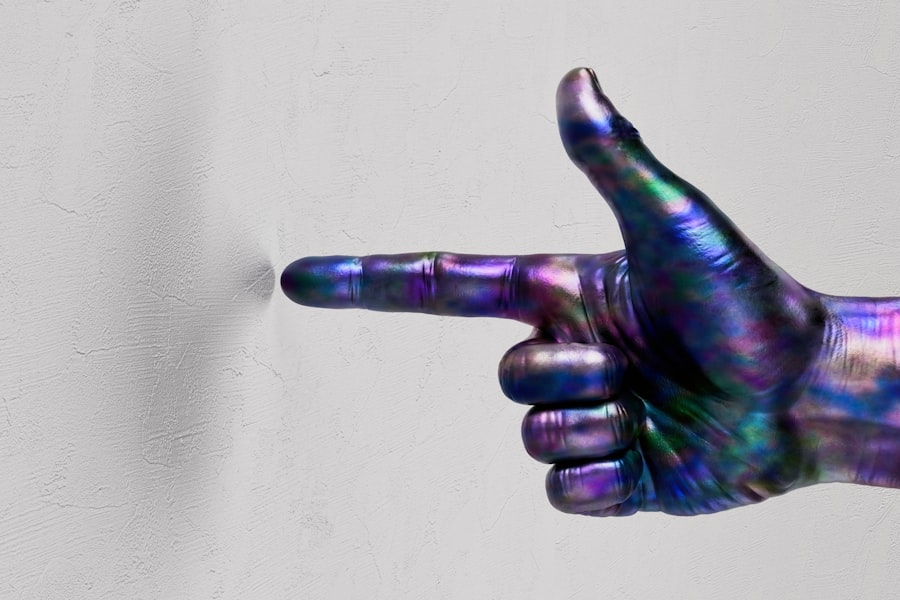
Despite the numerous advantages offered by hand tracking and gesture control technologies, several challenges remain that hinder their widespread adoption in VR applications.
While advancements have been made in sensor technology and machine learning algorithms, factors such as lighting conditions and occlusion can still affect performance.
For instance, if a user’s hands move too quickly or are partially obscured from view, the system may struggle to accurately track movements, leading to frustrating experiences. Another challenge lies in the learning curve associated with gesture control. While some gestures may feel intuitive, others may require users to adapt their behavior significantly.
This adaptation process can be particularly challenging for individuals who are not accustomed to using gesture-based interfaces. Additionally, there is a risk of misinterpretation; gestures that are common in one culture may not be understood in another, potentially leading to confusion during social interactions within VR environments.
Future Developments and Innovations in Hand Tracking and Gesture Control for VR
The future of hand tracking and gesture control in VR is poised for exciting developments as technology continues to advance at a rapid pace. One area of focus is improving the accuracy and responsiveness of hand tracking systems through enhanced sensor technologies and machine learning techniques. Companies are exploring new ways to integrate depth sensors and advanced computer vision algorithms that could allow for more precise tracking even in challenging environments.
Moreover, there is potential for integrating haptic feedback into hand tracking systems. By providing tactile sensations that correspond with virtual interactions—such as feeling resistance when grabbing an object—developers could create even more immersive experiences that engage multiple senses simultaneously. This integration could revolutionize applications ranging from gaming to training simulations by making virtual interactions feel more lifelike.
Another promising avenue is the development of cross-platform compatibility for hand tracking technologies. As VR continues to expand across various devices—from standalone headsets to high-end PC setups—ensuring that hand tracking works seamlessly across platforms will be crucial for widespread adoption. This interoperability could lead to richer social experiences where users can interact regardless of their hardware choices.
The Potential Impact of Hand Tracking and Gesture Control on the Future of VR
The integration of hand tracking and gesture control into virtual reality represents a significant leap forward in creating immersive digital experiences that closely mirror real-world interactions. As these technologies continue to evolve, they hold the potential to redefine how we engage with virtual environments across various sectors—from entertainment and education to healthcare and professional training. By enabling natural interactions that enhance user agency and presence, hand tracking and gesture control are set to play a pivotal role in shaping the future landscape of virtual reality.
As developers continue to address existing challenges and explore innovative solutions, we can anticipate a future where hand tracking becomes an integral part of everyday VR experiences. The possibilities are vast; from enhancing social interactions within virtual spaces to revolutionizing professional applications through intuitive design tools, the impact of these technologies will likely be profound. As we stand on the brink of this new era in virtual reality, it is clear that hand tracking and gesture control will be at the forefront of creating richer, more engaging digital worlds that resonate deeply with users’ innate desire for connection and interaction.
In exploring the significance of hand tracking and gesture control in enhancing virtual reality immersion, it’s interesting to consider how these technologies can be applied in various fields. For instance, the article on the best lighting design software of 2023 discusses innovative tools that can benefit from intuitive user interfaces, much like those found in VR environments. By integrating gesture control, designers can manipulate lighting elements more naturally, leading to a more immersive and efficient creative process.
FAQs
What is hand tracking in virtual reality (VR)?
Hand tracking in VR refers to the technology that allows a VR system to detect and interpret the movements and positions of a user’s hands without the need for physical controllers. This is typically achieved through cameras and sensors that capture hand gestures and translate them into digital inputs.
How does gesture control enhance VR immersion?
Gesture control enhances VR immersion by enabling users to interact with the virtual environment in a natural and intuitive way. Instead of relying on buttons or controllers, users can use their hands to manipulate objects, navigate menus, and communicate, which creates a more seamless and engaging experience.
What are the benefits of using hand tracking over traditional VR controllers?
Hand tracking offers several benefits over traditional controllers, including increased freedom of movement, more natural interactions, and reduced physical barriers between the user and the virtual environment. It also allows for more expressive communication through gestures and can improve accessibility for users who may have difficulty using standard controllers.
Which VR devices currently support hand tracking and gesture control?
Several VR devices support hand tracking and gesture control, including the Oculus Quest and Quest 2, which use built-in cameras for hand tracking. Other platforms and headsets may support hand tracking through external sensors or third-party accessories.
Are there any limitations to hand tracking technology in VR?
Yes, hand tracking technology can have limitations such as reduced accuracy in low-light conditions, limited tracking range, and difficulty recognizing complex or fast gestures. Additionally, some systems may experience latency or occasional tracking loss, which can affect the overall user experience.
How does hand tracking impact VR application development?
Hand tracking requires developers to design user interfaces and interactions that accommodate natural hand movements and gestures. This can lead to more immersive and intuitive applications but also demands additional development effort to ensure accurate gesture recognition and responsive feedback.
Can hand tracking be used for accessibility in VR?
Yes, hand tracking can improve accessibility by allowing users who have difficulty using traditional controllers to interact with VR environments using natural hand movements. This can make VR experiences more inclusive for people with various physical abilities.
What future advancements are expected in hand tracking and gesture control for VR?
Future advancements may include improved sensor accuracy, better gesture recognition algorithms, integration of haptic feedback for tactile sensations, and more seamless blending of hand tracking with other input methods. These improvements aim to create even more immersive and realistic VR experiences.